The Quiet Hour in Post-Op
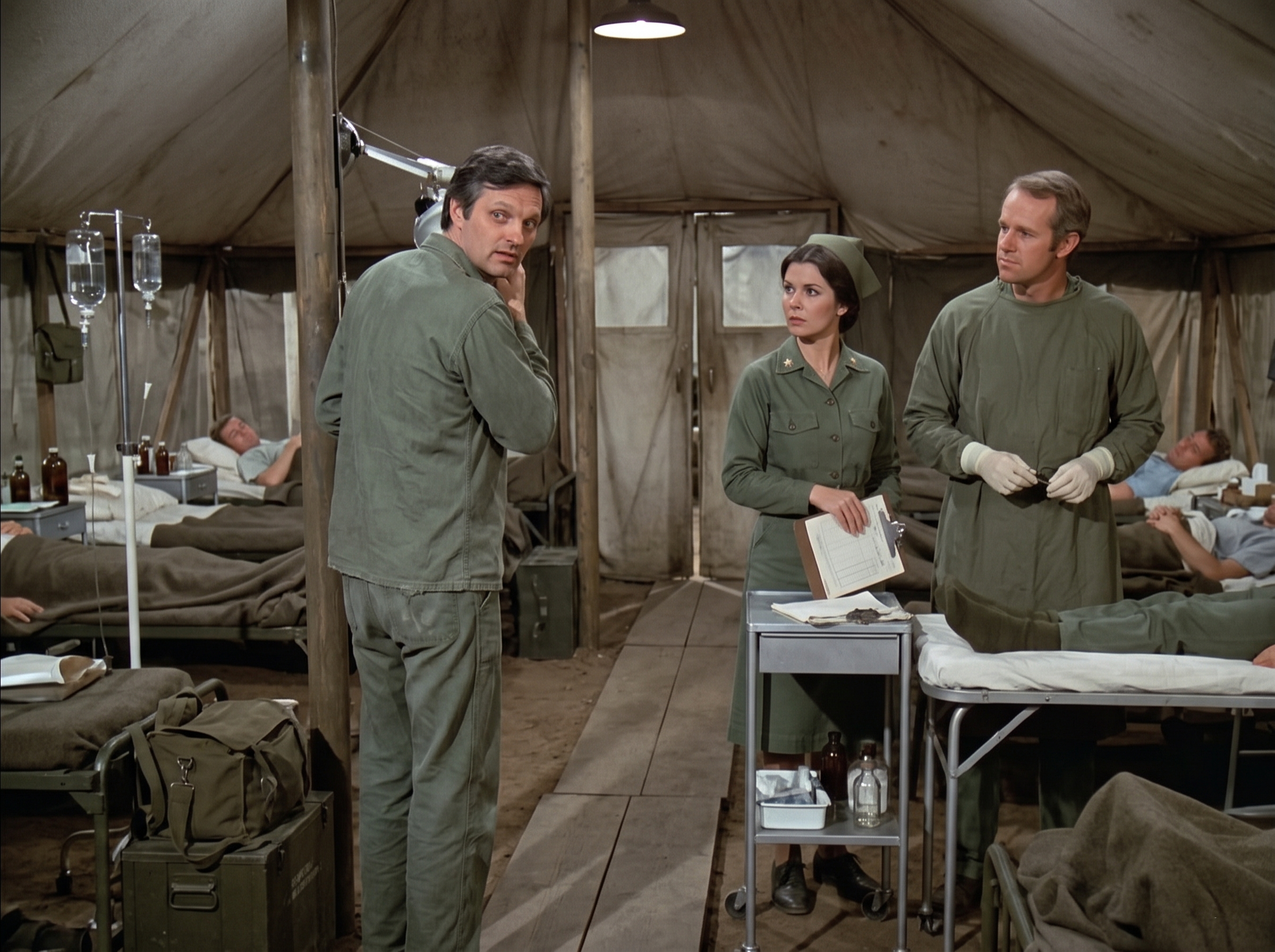
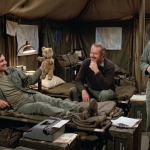
The canvas walls of Post-Op always held a specific kind of silence, the kind that didn’t come from lack of noise, but from the collective holding of breath. It was that hollowed-out hour just after a long shift, where the generator hum seemed to vibrate right into your marrow.
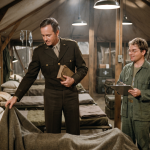
Hawkeye stood by the wooden support beam, his fatigue so heavy it looked like he was wearing it like a physical garment. He had that distant, thousand-yard stare, his fingers resting absently against his cheek, as if trying to hold his own face together.
Across from him, Margaret Houlihan was trying to be the bedrock. She held her clipboard with a grip so tight her knuckles had gone white, her eyes darting between a chart and the men resting on the cots. She was trying to manage the chaos of the room, but the effort was fraying at the edges of her composure.
Then there was B.J., standing near the gurney, his surgical gloves still on, his expression one of weary, steadying kindness. He wasn’t looking at the patient; he was looking at Hawkeye. He knew that look—the one where the jokes ran dry and the world felt like it was tilting just a few degrees too far to the left.
The air smelled of antiseptic, damp earth, and the lingering, metallic tang of too many hours in the OR. A patient shifted on a cot in the background, a soft groan escaping his lips, and the sound hung in the air like a discordant note.
Margaret’s clipboard clattered slightly as she adjusted her stance, her eyes meeting Hawkeye’s. The look they exchanged wasn’t filled with the usual banter or professional friction. It was raw, unvarnished exhaustion, a silent admission that the day had taken more than it had given.
Hawkeye suddenly broke his pose, stepping forward with a sharp, ragged intake of breath that signaled the wall he’d built against the day was finally about to crumble.
“I’m not doing it, Margaret,” Hawkeye said, his voice quiet but cracking with a sudden, sharp edge of frustration. “I’m not doing the ‘everything is fine’ dance again today. The ledger is empty. I’m out of patience, I’m out of wisecracks, and frankly, I think I’m out of hope for a decent cup of coffee.”
B.J. didn’t jump. He just leaned slightly against the cart, his presence a calm anchor in the center of the storm. He knew that when Hawkeye started snapping, it wasn’t about the coffee, or the war, or the patients—it was about the fact that they were all still human, and they were all still trapped in the same nightmare.
“We aren’t doing any dances, Hawk,” B.J. said softly, his voice cutting through the tension like a warm blanket. “I think we’re just doing the ‘survive until dinner’ routine. And for the record, I’ve got a jar of instant buried in my locker that isn’t half bad. It’s got a kick like a mule and about the same flavor profile, but it’s hot.”
Margaret looked at the two of them, her shoulders finally dropping a fraction of an inch. She let out a long, slow sigh, the starch in her uniform seemingly softening as she looked at the clipboard, then back at them. The professional distance she usually maintained to protect herself slipped, leaving behind the woman who cared far more than she ever dared to admit.
“You two are impossible,” she muttered, though there was no heat in it. She walked over to the supply cart and set the clipboard down, her hand lingering on the metal edge. “But if you’re making coffee, you’re using the good tin. I’m not drinking your swamp water.”
Hawkeye looked at them, the manic energy in his eyes dimming into something softer, something tired and profoundly grateful. He rubbed his face with both hands, a small, genuine smile creeping across his lips for the first time since sunrise.
“You know,” he murmured, glancing back at the men resting in the cots, “it’s a strange thing. We spend all day trying to fix the world, and half the time, we’re just hoping someone will remind us that we’re still here.”
B.J. nodded, pulling his gloves off one by one and tossing them into the bin. “That’s what the 4077th is, Hawk. It’s the place where we hold each other up so we don’t have to carry the whole weight alone.”
The tension in the tent didn’t vanish—this was still Korea, and the war was still right outside those canvas flaps—but the crushing weight of it had shifted. They stood there for a moment in the dim light, three people who had seen too much, finding comfort in the simple, quiet reality of being together.
The generator continued its rhythmic pulse, the patients slept, and for a few minutes, the war felt just a little bit smaller.
In the heart of the madness, all we ever really had was each other.