The Frame of Mind at the 4077th
Some days in Korea, the mud didn’t just stick to your boots; it seeped straight into your soul.
After an grueling seventy-two hour shift in the Operating Room, the world usually shrunk down to the size of a cot and a heavy, dreamless sleep. But today, a strange rumor had traveled faster than a piece of shrapnel through the camp, pulling three exhausted men into the dim, canvas-scented confines of the supply tent.
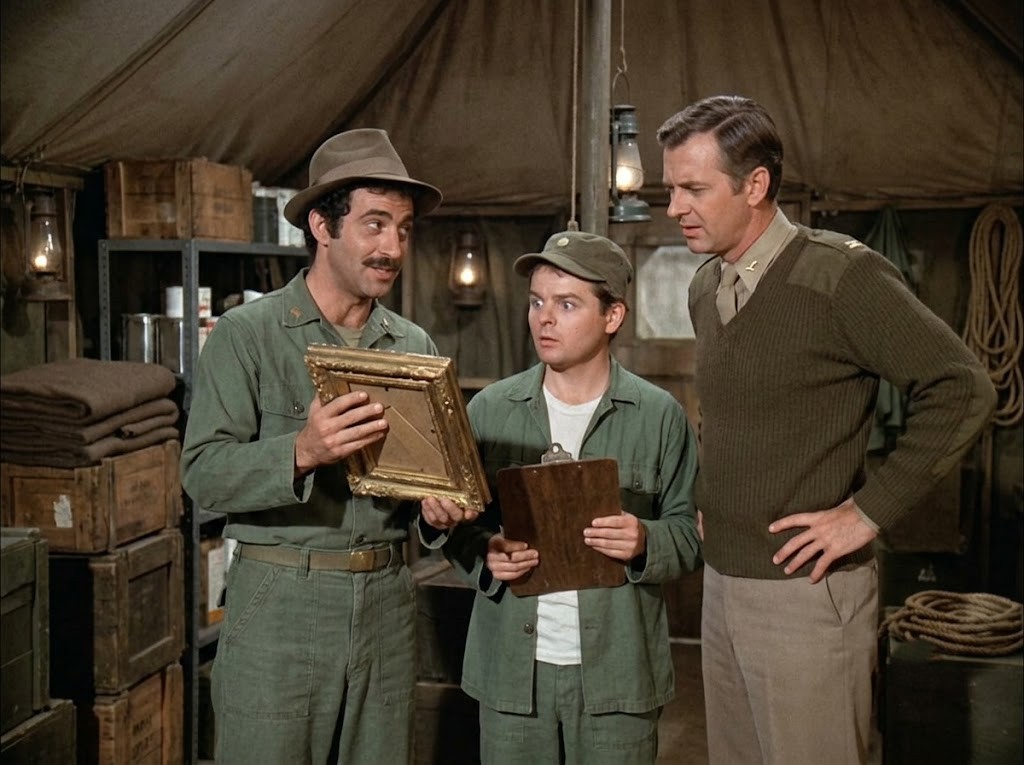
Hawkeye Pierce stood by the wooden crates, his boonie hat tilted back, holding a heavily gilded, ornate picture frame. He wasn’t looking at a masterpiece; in fact, the frame was completely empty, its cardboard backing exposed to the room.
Beside him, Radar O’Reilly held his clipboard like a shield, his eyes wide behind his glasses, staring at the golden object with a mix of awe and deep-seated panic.
Even Captain B.J. Hunnicutt, usually the anchor of sanity in the swamp of their exhaustion, had his hands on his hips, his brow furrowed as he stared down at the artifact with intense gravity.
“Radar, let me ask you something,” Hawkeye said, his voice carrying that familiar, raspy edge of a man who had smoked too many cigarettes and cracked too many jokes to keep from crying. “Did the U.S. Army supply catalog suddenly merge with the Louvre, or did General MacArthur personally authorize a shipment of Renaissance decorum to the front lines?”
Radar blinked, shifting his weight from one foot to the other. “Sir, it came in the morning supply truck from Seoul. It was listed under ‘Miscellaneous Medical Containers, Rigid.’ I thought it was a new kind of traction splint until Captain Hunnicutt opened the box.”
B.J. let out a soft, dry chuckle, shaking his head. “A traction splint for King Louis XIV, maybe. Look at those carvings, Hawk. That’s real gold leaf, or a very convincing imitation made by a private who wanted to get out of guard duty.”
The contrast was absurd. Around them were stacks of rough, olive-drab wool blankets, unpainted wooden crates, and the cold metal of industrial shelving. Yet, in Hawkeye’s hands, the frame glowed like a misplaced sun, radiating an aggressive, unapologetic beauty that didn’t belong within a hundred miles of a war zone.
“It’s beautiful,” Radar whispered, almost to himself, reaching out a hand before quickly pulling it back, as if touching it might break the spell—or worse, alert Section 8.
“It’s more than beautiful, Radar. It’s a philosophical conundrum,” Hawkeye proclaimed, stepping into the center of the tent. “An empty frame in a place like this. It’s the perfect metaphor for our lives here. We’ve got the structure, we’ve got the borders, but the picture inside is completely blank. We’re just waiting for someone to paint the ending.”
B.J. smiled softly, though his eyes remained tired, carrying the permanent weight of a man missing his daughter’s childhood across an ocean. “Or maybe it’s just a mistake, Hawk. A clerk in Tokyo hit the wrong key on a mimeograph machine, and instead of a crate of sterile gauze, we got a home for a missing Rembrandt.”
“Don’t ruin my poetry with your cold, hard logistics, Beej,” Hawkeye countered, turning the frame over in his hands. “This is an omen. A sign from the gods of art and culture that we are still civilized men. I think we should hang it in the Swamp. Right over the still.”
“Colonel Potter will have a fit, sir,” Radar warned, his voice dropping an octave as he looked toward the tent flap. “He’s already upset about the inventory discrepancy. If he finds out we’re hoarding high-society furniture while we’re short on penicillin, he’ll have us filling sandbags until the armistice.”
Hawkeye didn’t listen. He held the frame up, framing B.J.’s face within the gold borders. “See? A portrait of a young, dashing surgeon, longing for San Francisco and a decent glass of milk. It elevates you, Beej. It turns your fatigue into high art.”
“Try framing Radar,” B.J. suggested, leaning in. “A study in military confusion. We could call it *The Boy with the Clipboard*.”
Radar blushed, looking down at his papers. “Gee, captains, I don’t think…”
Before Radar could finish, the heavy canvas flap of the supply tent snapped open, letting in a sharp gust of wind and the unmistakable, heavy tread of Colonel Sherman Potter.
The room went dead silent. The golden frame seemed to catch the lantern light, glowing twice as bright as before, casting a mocking, luxurious reflection across the stern, weathered face of the camp commander.
Colonel Potter stood in the entrance, his hands tucked firmly into his jacket pockets, his eyes narrowing as they flicked from Hawkeye, to the frame, to B.J., and finally to a sweating Radar.
“Alright, Pierce, Hunnicutt,” Potter barked, his voice like gravel grinding in a bucket. “What in the name of the Great Caesar’s Ghost is going on in here? I’m missing three boxes of surgical soap, and I find my two chief surgeons admiring the crown jewels.”
Hawkeye didn’t lower the frame. Instead, with a smooth, practiced elegance, he shifted his stance and held the empty gold rectangle directly up, framing Colonel Potter’s face perfectly within the ornate border.
“Ah, Colonel! Just in time,” Hawkeye said without missing a beat. “We were just reviewing the latest addition to the 4077th portrait gallery. We call this one *The Masterpiece of Missouri*. Notice the subtle nuance of the scowl, the historical weight of the eyebrows, the quiet dignity of a man who has seen three wars and still prefers horses to people.”
B.J. bit his lip to hide a grin, stepping back slightly to give the performance room. Radar looked like he wanted to dissolve into the floorboards.
Potter didn’t move. He stared through the empty gold box at Hawkeye for three long, agonizing seconds. Then, slowly, he raised a hand, tapped the frame with a single, blunt index finger, and let out a long sigh that deflated his stern posture.
“Pierce, if I wanted to be framed, I’d go down to the stockade,” Potter said, though the gravel in his voice had softened into something resembling a tired amusement. “Lower that thing before you give O’Reilly a stroke. Look at him, he’s turning the color of a bad cabbage.”
Hawkeye lowered the frame gently, resting it against a crate of blankets. “Come on, Colonel. Give us this one. It’s the only thing in this camp that doesn’t smell like ether or boiled cabbage. Where do you think it came from?”
Potter walked over, his eyes softening as he looked down at the intricate carvings. He reached out, his thumb tracing a small, molded leaf in the corner. For a moment, the colonel wasn’t in Korea. He was back in a quiet parlor in Hannibal, looking at the old family photographs on his wife Mildred’s piano.
“It’s an old Victorian style,” Potter said quietly, his voice losing its military edge completely. “My grandmother had one just like it. Held a picture of my grandfather in his Spanish-American War uniform. Heavy thing. Solid wood underneath the gilt.”
The tent grew quiet, the kind of stillness that only happened when the reality of home managed to slip past the sandbags and the barbed wire.
“What do we do with it, sir?” Radar asked softly, his panic completely gone, replaced by the earnest curiosity of a kid from Iowa. “Do I send it back on the supply truck?”
Potter looked at Radar, then at B.J., and finally at Hawkeye. He saw the dark circles under their eyes, the faint stains of dried blood on the edges of their fatigues, and the desperate, fragile need for something—anything—that resembled a normal world.
“The Army made a mistake, Radar,” Potter said, turning back toward the exit. “And if there’s one thing I’ve learned in thirty years, it’s that you never correct the Army when their mistakes are this pretty. Mark it down as damaged medical scrap. Unsalvageable.”
“And the frame, Colonel?” Hawkeye asked, a genuine smile breaking through his exhaustion.
“I don’t care what you do with it,” Potter said, paused at the tent flap, his back to them. “But if it doesn’t have a picture of Radar’s dog, or Hunnicutt’s kid, or Pierce’s old man in it by tomorrow morning, I’m turning it into kindling for the mess hall stove.”
With a sharp nod, the old man disappeared back into the gray Korean afternoon.
B.J. looked at Hawkeye, a gentle warmth in his eyes. “Well, Hawk. Looks like we have a canvas to fill.”
Hawkeye looked down at the golden borders, the empty space inside suddenly feeling less like a metaphor for their loneliness, and more like a promise of what was waiting for them on the other side of the ocean.
“Radar,” Hawkeye said quietly, handing the frame to the young corporal. “Go get that snapshot of your mother from your locker. Let’s give this piece of junk some real value.”
In the middle of a forgotten war, the men of the 4077th learned that you didn’t need a masterpiece to make a frame beautiful; you just needed a piece of home to put inside it.