The Red Silk Scarf and the Inventory of the Heart
Some days, the war doesn’t knock on the door with the thunder of incoming choppers or the metallic smell of the OR. Sometimes, it just creeps into the supply tent on a chilly Tuesday morning, tucked inside a wooden crate that traveled ten thousand miles from home.
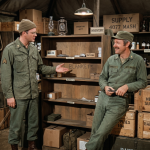
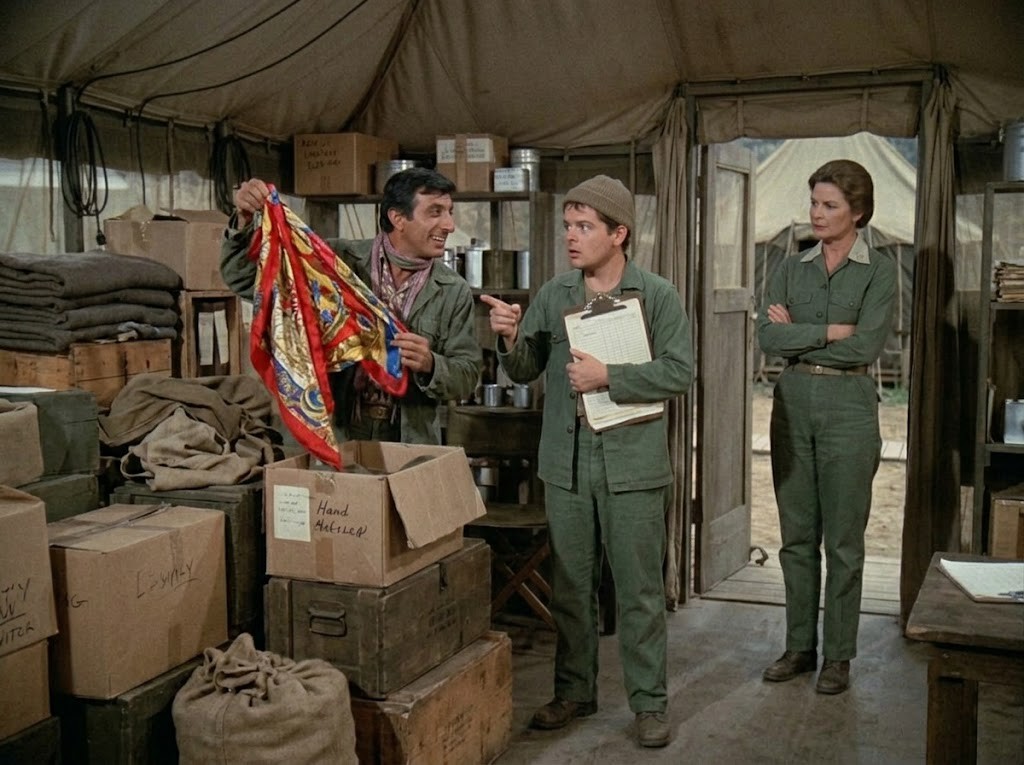
In the dim light of the 4077th supply depot, Radar O’Reilly held his clipboard like a shield against the endless mountain of paperwork. His brow was furrowed, his knitted cap pulled low against the draft, his eyes darting between the columns of figures and the man standing across from him.
Corporal Klinger was holding up a brilliant, shimmering piece of red silk, patterned with intricate gold and blue patterns. It was completely useless for a military camp in Korea, which meant, to Klinger, it was the most beautiful thing in the world.
“Look at this, Radar,” Klinger whispered, his voice a mix of awe and theatrical triumph. “This isn’t just fabric. This is a ticket out of the mud. This is high fashion from a boutique in Ohio that accidentally got mixed up with a shipment of canvas tarp.”
Radar shook his head, pointing an official finger at the open cardboard box marked *Hand Mittens*.
“Klinger, the manifest says we’re missing forty pairs of heavy-duty wool mittens for the night shift,” Radar said, his voice rising in an earnest, nervous squeak. “If Major Houlihan catches you swapping winter gear for… for whatever that fancy rag is, she’ll have both our heads on a platter.”
Right on cue, the tent flap rustled open, and Major Margaret Houlihan stepped into the room.
Her arms were crossed tightly over her olive-drab uniform, her expression a mask of stern military discipline. She had come to find out why the nursing staff was still freezing through their evening rounds, and the sight of a colorful silk scarf in Klinger’s hands did nothing to soften her gaze.
“What is the meaning of this, Corporal?” Margaret asked, her voice sharp enough to cut through the canvas walls. “Is this where our winter supplies went?”
Klinger froze, his smile faltering, but he kept his grip tight on the silk. He looked at Radar, then at Margaret, his eyes wide with a sudden, deep vulnerability that went far beyond his usual schemes.
“Major,” Klinger said quietly, the theatricality draining from his voice. “It’s not what you think.”
The silence in the supply tent stretched out, heavy with the weight of a hundred sleepless nights and the biting Korean wind outside. Radar looked down at his clipboard, suddenly unable to meet Margaret’s intense, searching glare.
“The box arrived from Toledo, Major,” Radar murmured, his voice softening. “But it wasn’t an army shipment. It was addressed to Klinger. Personally.”
Margaret’s posture didn’t change, but her eyes flicked from Radar to the vibrant red cloth resting in Klinger’s calloused hands.
“My grandmother made it,” Klinger said, his voice unusually steady, devoid of any comedic deflection. “She’s eighty-two, and her hands shake so bad she can barely hold a fork. But when she heard how cold the winter gets over here, she spent three months sewing this together from old dress scraps.”
He smoothed a wrinkle in the silk, his thumb tracing a golden thread.
“She thought it would keep me warm,” Klinger added with a faint, bittersweet smile. “She didn’t know the army only allows olive drab.”
Margaret looked at the scarf. It was loud, completely non-regulation, and utterly beautiful against the drab, grey-green backdrop of the supply tent. She thought of her own family, of the sterile military discipline she had been raised on, and the rare, fragile moments of genuine warmth that managed to survive in a place like this.
Slowly, her arms uncrossed. The stern mask didn’t entirely disappear—she was still the Chief Nurse of the 4077th—but her shoulders dropped just a fraction.
“It’s a clear violation of uniform code, Corporal,” Margaret said, her tone quiet, lacking its usual sting. “If Colonel Potter or Major Winchester sees you wearing that around the compound, I’ll have to write a report.”
Klinger’s face fell slightly, nodding in resignation. “I understand, Major. I’ll put it away.”
“However,” Margaret continued, stepping a bit closer and reaching out to touch the corner of the fabric, feeling its unexpected warmth. “The night shifts in the triage tents are brutal. The draft comes right through the canvas. If a soldier were to wear a piece of home *underneath* their heavy parka, completely out of sight… well, what the registry doesn’t see isn’t my concern.”
Radar looked up from his clipboard, a wide, relieved smile breaking across his face. He quickly tapped his pencil against the paper.
“I’ll just list the missing mittens as ‘delayed in transit due to weather,’ Major,” Radar said happily. “The paperwork will match perfectly by Friday.”
Klinger looked at Margaret, his eyes shining with a profound gratitude that no joke could cover up. He pulled the scarf close, tucking it gently into his pocket, close to his heart.
“Thank you, Major,” Klinger whispered.
Margaret gave a single, firm nod, her professional composure fully restored. “Just make sure those wool mittens are found by tomorrow morning, O’Reilly. Dismissed.”
As she turned and walked out into the cold camp, the two corpsmen stood together in the quiet tent. The war was still waiting outside, but for a few minutes, the mud of Korea felt just a little bit further away.
In the corner of a forgotten supply tent, a single thread of family warmth was enough to keep the cold world at bay.