The Quiet Mechanics of Keeping Time
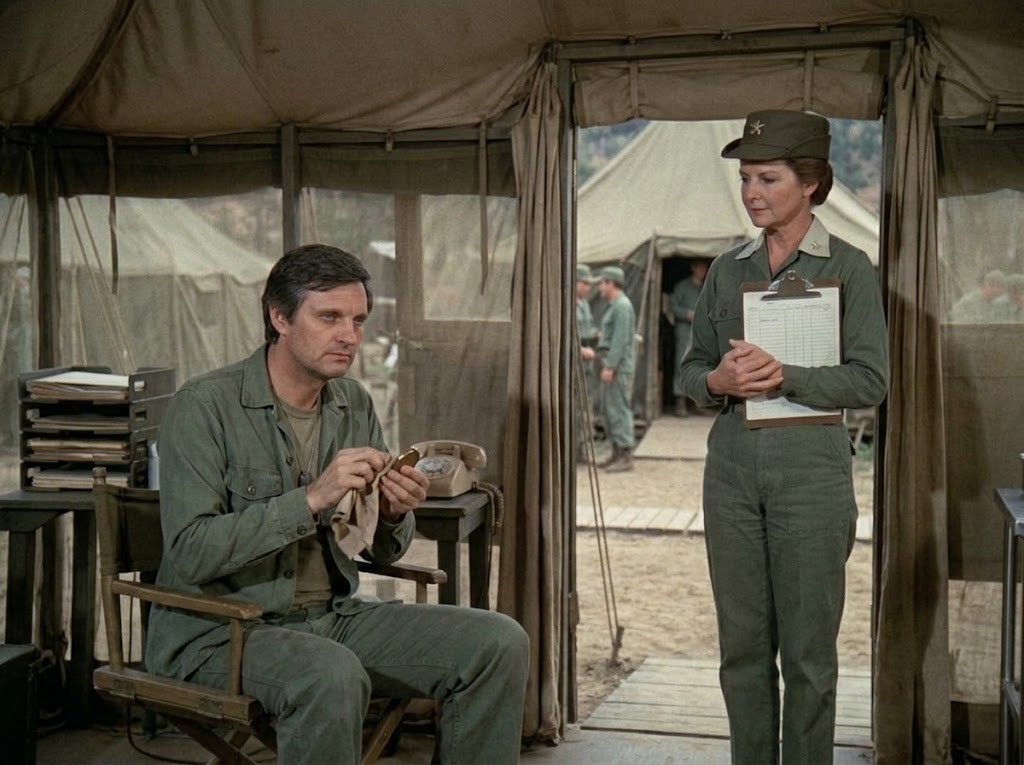
Sometimes, the loudest sound in the entire Korean peninsula was the sudden, ringing silence right after the last chopper left.
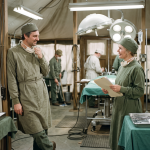
The OR had finally emptied out after a brutal thirty-six-hour stretch, leaving behind the usual cocktail of exhaustion, phantom smells of ether, and a deep, aching fatigue that settled straight into the marrow of your bones.
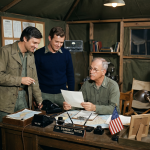
Hawkeye Pierce didn’t go back to the Swamp. He didn’t think he could face the still, heavy air of his tent or the sight of his unmade cot without completely collapsing, so instead, he found himself wandering into the relative quiet of the administrative tent.
He sank heavily into the wooden director’s chair near the desk, his long legs stretching out as if they belonged to someone else entirely. His olive-drab fatigues were rumpled, stained with the invisible residue of a dozen touch-and-go surgeries, and his eyes carried the hollow, faraway stare that always came when the adrenaline finally ran out.
From his pocket, he pulled out a small, round brass pocket watch. It wasn’t an expensive piece, just an old, scratched heirloom his father had given him before he boarded the transport ship out of San Francisco, a tangible piece of Crabapple Cove that usually offered a strange kind of comfort.
But today, the ticking felt heavy, almost mocking. He fished a graying rag from the corner of the desk and began to rub the brass casing, over and over, trying to polish away the mud, the sweat, and the sheer weight of the last two days.
“You’re going to rub the gold clean off that thing, Pierce.”
The voice was quiet, stripped of its usual military sharpness. Hawkeye didn’t look up, but his hand slowed down for just a second.
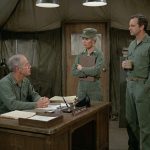
Major Margaret Houlihan stood in the open doorway of the tent, her clipboard clutched tightly against her chest like a shield. Her uniform was as immaculate as thirty-six hours in the mud would allow, her cap pinned neatly, but her face held a rare, unmonitored softness as she looked down at the resident cynic of the 4077th.
Through the screened windows of the tent, the rest of the camp was a blur of slow-moving green uniforms. Two exhausted corpsmen stumbled past the doorway in the dust, their shoulders slumped, too tired to even exchange the usual morning gripes.
“It’s not gold, Margaret,” Hawkeye said, his voice barely a raspy whisper, his fingers resuming their rhythmic, frantic polishing of the watch. “It’s just brass. Cheap brass. But if I keep rubbing it, maybe I can make it turn the hands backward to last Tuesday, before that kid from Ohio broke down on my table.”
Margaret stepped closer, the wooden floorboards groaking softly under her boots. She didn’t offer a biting retort, and she didn’t command him to snap out of it.
Instead, she just watched him, her eyes clouded with an unspoken understanding that bypassed all the regulations, all the arguments, and all the ranks they so fiercely guarded.
“Hawkeye,” she whispered, her voice cracking slightly as she saw the slight tremble in his hands. “Stop. Just… stop.”
Hawkeye’s fingers froze against the brass casing. He stared at the scratched crystal of the watch, his breathing shallow, the silence between them suddenly feeling as fragile as glass.
For a long moment, the only sound was the distant, rhythmic hum of the generator outside. The sarcastic, fast-talking surgeon who always had a joke to deflect the horror was completely gone, replaced by a tired man holding a broken piece of home.
Margaret took another step forward, lowering her clipboard slightly. “Radar just got the casualty reports filed,” she said softly, her eyes never leaving his face. “Colonel Potter went to his tent to write to Mildred. B.J. is already asleep with his boots still on.”
Hawkeye finally looked up, his blue eyes meeting hers. There was no mockery in his expression, no smirk, just the raw transparency of a man who had given everything he had to a dozen strangers on an operating table and was now running on empty.
“He was nineteen, Margaret,” Hawkeye said quietly, his thumb tracing the rim of the watch. “The kid from Ohio. He kept asking me what time it was back home. He wanted to know if his mother was awake yet. And I couldn’t look at my watch because my hands were covered in… well. I just told him it was breakfast time.”
Margaret closed her eyes for a brief second, swallowing the lump in her throat. She knew the boy he was talking about; she had held the clamp while Hawkeye worked.
“You gave him comfort, Hawkeye,” she said, her voice steady but deeply tender. “You gave him a piece of ordinary life when everything else was falling apart. That’s not nothing.”
“It feels like nothing,” he muttered, looking back down at the watch. “Time just keeps moving forward here, whether we’re ready for it or not. This stupid thing just keeps ticking, completely indifferent to who stays and who goes.”
The tent flap rustled, and Father Mulcahy quietly stepped inside, holding a small metal tray with two steaming tin cups of tea. He took one look at the scene—Hawkeye slumped in the chair, Margaret standing guard like a protective, sorrowful angel—and understood everything without a word being spoken.
The gentle priest set the tray down on the corner of the desk, right next to the dusty telephone. He reached out, placing a comforting hand on Hawkeye’s shoulder for a brief, warm moment.
“The camp is quiet now, Pierce,” Mulcahy said softly, his voice a soothing balm in the quiet room. “The best thing we can do for the ones we lost is to take care of the ones who are still standing. Drink some tea. Get some rest.”
Mulcahy gave Margaret a small nod of mutual respect and quietly slipped back out into the compound, leaving the two of them alone once more.
Margaret reached out, her fingers gently touching the top of the clipboard she still held against her uniform. “He’s right, you know. Even Winchester has stopped playing his phonograph for the day. The whole camp is holding its breath, waiting for you to realize that you’re allowed to be human, too.”
A ghost of a smile finally touched Hawkeye’s exhausted face, though it didn’t quite reach his eyes. “Charles, quiet? I must be more tired than I thought. I might start hallucinating that Klinger is wearing a sensible wool suit.”
Margaret let out a short, soft laugh, the tension in her shoulders visibly easing. “Don’t count on it. He was eyeing a taffeta skirt in the Sears catalog just this morning.”
She watched as Hawkeye slowly let the polishing rag drop to his lap. He carefully clicked the pocket watch shut, the sharp *snap* signaling the end of his internal vigil. He slipped the timepiece back into his breast pocket, patting it once through the worn fabric.
“Thanks, Margaret,” he said honestly, his voice devoid of his usual theatricality.
“Get some sleep, Hawkeye,” she replied, her professional composure returning like a familiar coat, though her eyes remained fiercely warm. “That’s an order.”
She turned and walked toward the tent exit, her clipboard held firmly at her side, ready to face whatever bureaucratic nonsense or medical crisis the afternoon would inevitably bring.
Hawkeye sat alone in the quiet office for a few more minutes, listening to the slow, steady heartbeat of the 4077th recovering around him. For the first time in two days, the ticking of the watch in his pocket didn’t feel like a countdown—it just felt like time, carrying them all a little bit closer to home.
In the mud and madness of the 4077th, it wasn’t the rank on your shoulders that kept you together, but the quiet, unspoken grace of the people who refused to let you fall apart.