The Sweetness of the 4077th
The mud outside was up to our ankles, the generator was coughing like an old mule, and the smell of sterilized gauze and cheap coffee hung thick in the air. We had just finished a grueling thirty-six-hour shift in the O.R., where time stopped and the world shrunk down to the size of an operating table.
My hands were still trembling slightly from the sheer exhaustion, that familiar ache settling deep into the marrow of my bones.
I was sitting on the edge of the cot, staring blankly at the canvas floor, trying to forget the sound of mortar shells echoing in the distance.
Then, the tent flap brushed open.
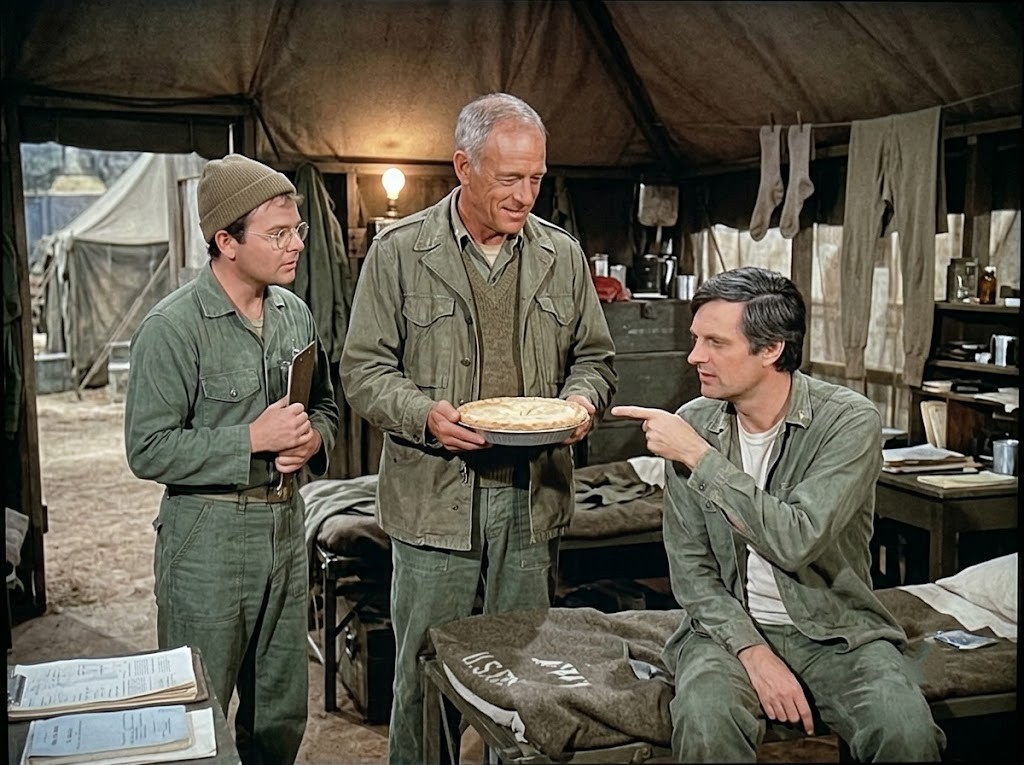
In walked Colonel Potter, looking remarkably spry for a man who had been up just as long as the rest of us, flanked by Radar, who was clutching his ever-present clipboard like a shield.
But it wasn’t the Colonel’s crisp posture or Radar’s wide-eyed innocence that caught my attention. It was what Potter was holding carefully in both hands.
A pie. A perfectly golden, freshly baked, honest-to-goodness pie.
I froze, my finger instinctively flying up to point at the golden crust as if I were staring at a mirage in the middle of the Sahara.
“Colonel,” I said, my voice dripping with equal parts suspicion and desperate hope, “if that is a genuine, home-baked pastry and not a visual hallucination brought on by sleep deprivation, I may have to kiss you right on your official military mustache.”
Potter let out a soft, warm chuckle, his eyes crinkling at the corners with that grandfatherly affection that somehow kept this whole crazy camp from spinning off its axis. “It’s real, Pierce. Fresh out of the mess hall oven, courtesy of a supply truck that accidentally brought in a crate of real apples instead of dehydrated cardboard.”
Radar nodded eagerly, looking between us like a kid on Christmas morning. “I checked the manifest myself, Hawk. No bugs, no dried-out nothing. It’s the real deal. Smells like… well, it smells like Iowa.”
I kept my finger leveled at the pie, entirely transfixed by the sight of it sitting there, pristine and whole, right in the middle of our drab, olive-drab world. It looked completely out of place, a small miracle of sugar and dough resting in the scarred hands of an old cavalry soldier.
But just as the wonderful aroma of baked apples and cinnamon began to cut through the stale stench of the tent, Radar’s expression suddenly shifted from excitement to pure panic. He looked down at his clipboard, his fingers fumbling with his pen, and his face went entirely pale.
“Uh, Colonel? Hawkeye?” Radar whispered, his voice cracking slightly. “We have a big problem.”
The silence that followed was heavier than a wet army blanket.
I kept my finger pointed at the pie, but my eyes darted up to Radar’s anxious face. “Radar, do not say those words. If you tell me that pie is classified, or that it belongs to General Hammond, I will personally use my stethoscope to garrote you.”
“It’s not that, Hawk,” Radar stammered, tapping his pen nervously against the wood of the clipboard. “I just re-read the shipment log. This wasn’t a mistake. It’s an official delivery. It’s a specialty item sent directly from the states for Captain B.J. Hunnicutt. It was baked by his wife, Peg, and sent in a special vacuum-sealed tin. It arrived an hour ago.”
Potter’s smile faltered just a bit, the warmth in his eyes giving way to a deep, knowing sympathy.
We all knew what day it was. It was B.J.’s wedding anniversary. He had spent the last three hours sitting by the swamp’s radio, trying to get a line through to San Francisco, only to be told the trans-Pacific lines were completely down due to a storm. He had crawled into his bunk twenty minutes ago, pulling the blanket over his head without saying a word to anyone.
I lowered my finger, the sudden rush of hunger vanishing, replaced by that familiar, heavy ache in the chest that we all carried around like a spare canteen.
“Peg sent it,” I murmured, looking back at the beautiful golden crust. “She baked it in California, packed it with love, and sent it across an ocean just so he could have a piece of home today.”
Potter looked down at the pie in his hands, his expression softening into something incredibly tender. “A man’s anniversary away from his family is a bitter pill to swallow, Pierce. Especially over here. This pie… this isn’t just dessert. It’s a piece of his heart.”
“He was crying earlier,” Radar whispered softly, looking at the floorboards. “When the operator hung up on him. He tried not to let me see, but his glasses were all foggy.”
The tent was quiet, save for the distant hum of the generator. For a moment, the three of us just stood there in the dim light, looking at the visual source of a family’s love sitting in an aluminum tin. In a place surrounded by so much destruction and exhaustion, this little pie was a fragile reminder that a beautiful world still existed outside the barbed wire.
“Well,” I said, clearing my throat to chase away the lump forming there, “we can’t just let him sleep through it. And we certainly can’t let him eat it alone. A pie like this requires a ceremony. It requires an audience.”
Potter grinned, his steady, fatherly warmth returning in full force. “Spoken like a true surgeon, Captain. Radar, fetch Winchester and Father Mulcahy. Tell them there’s an emergency in the living tent. A strictly administrative emergency.”
“Yes, sir!” Radar said, a bright smile returning to his face as he bolted out the flap.
Ten minutes later, the tent was filled with the quiet, comforting presence of our makeshift family. Major Winchester had arrived, initially complaining about the lack of proper silverware, but his aristocratic posture softened the moment he saw the steam rising from the tin. Father Mulcahy sat on the edge of a trunk, a gentle, understanding smile on his face, his hands folded neatly in his lap.
We woke B.J. up by waving the scent of the cinnamon crust right under his nose.
When he opened his eyes and saw the pie, and then saw the card Radar had carefully retrieved from the shipping box—signed with a tiny ink drawing of a heart and a child’s handprint from Erin—his face changed completely. The tiredness, the sorrow of the missed telephone call, the weight of the war—it all seemed to lift from his shoulders, if only for an hour.
He didn’t eat it alone. He insisted on cutting it into perfectly equal slices, ensuring everyone in the tent received a piece, even arguing with Winchester over who got the largest corner of crust.
As we sat there together in the quiet tent, eating Peg’s apple pie with mismatched spoons and plastic forks, the war felt a million miles away. We laughed at Potter’s old cavalry stories, groaned at my terrible puns, and watched Charles savor his slice as if it were served at a five-star restaurant in Boston.
It was a small, fleeting moment of sweetness in a very bitter place, a reminder that as long as we had each other, the 4077th would always feel a little bit like home.
Sometimes, the best medicine didn’t come from a bottle, but from a tin pan and the people who refused to let you eat alone.