A Moment of Unscheduled Grace
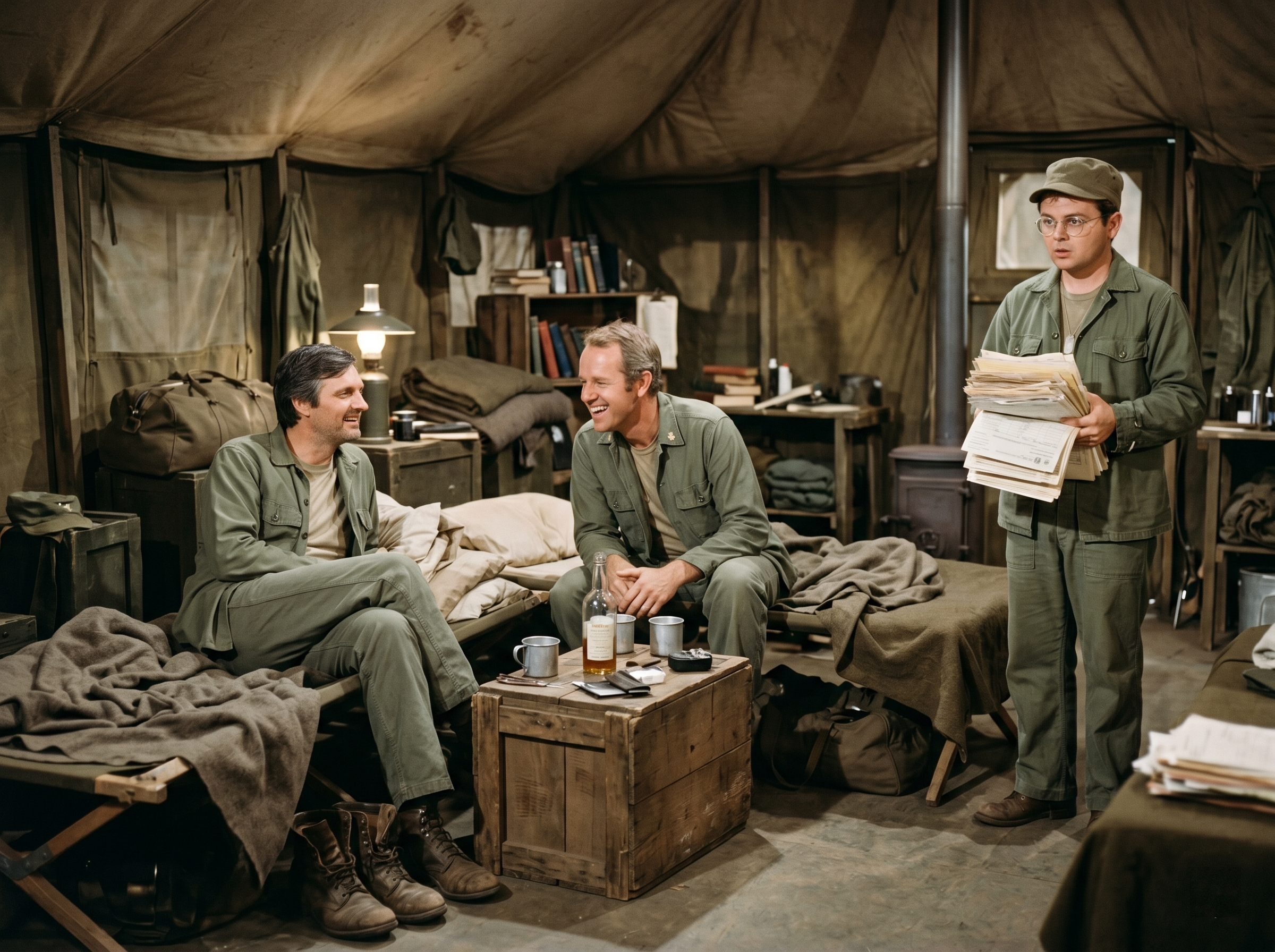
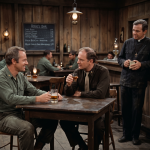
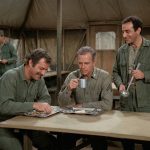
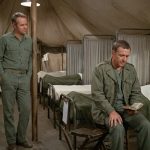
It was one of those rare, stolen evenings when the Swamp actually felt like a home, not just a drafty canvas waiting room for the next catastrophe.
The wind wasn’t howling, the generator was singing a low, consistent tune, and for the first time in three days, there were no incoming choppers.
Hawkeye Pierce had claimed his favorite spot, boots off, legs crossed, leaning against the makeshift headboard of his cot.
A smirk played across his lips, the kind that usually meant he’d found a crack in the universe of chaos and was busy widening it.
Opposite him, on the next cot, B.J. Hunnicutt was mid-laugh, leaning forward on his elbows.
He was looking at Hawkeye, completely surrendered to the absurd joy of the moment, his expression warm and grounded.
Between them sat a sturdy wooden crate, their coffee table, dinner table, and tonight, their altar of relaxation.
Upon it rested a bottle of true bourbon—not the usual medicinal-grade substitute that doubled as paint stripper.
Next to it were two metal mess cups, their contents glinting in the soft, amber glow of the kerosene lantern.
“I’m telling you, Beej,” Hawkeye said, gesturing with his free hand, “if I had a nickel for every time I’ve been right this week, I could buy a small island in Maine and never have to look at another olive drab tent again.”
B.J. shook his head, his laugh receding into a pleasant grin. “If you had a nickel for every time you were *this* smug about it, you could buy the whole state.”
A quiet, comfortable silence settled, the kind only found among people who had seen each other’s souls under pressure.
Hawkeye raised his cup. “To sanity, my friend. A very quiet, very efficient, and entirely unplanned five minutes of it.”
Their cups had just clicked when the tent flap whipped open with an urgent, clumsy rustle.
The fragile peace shattered instantly.
A tall, towering pillar of man-made administration marched into the tent, almost completely obscuring the body carrying it.
Radar O’Reilly had arrived, and he wasn’t just bearing paperwork; he *was* paperwork.
He held a stack of files, forms, requisitions, and directives that must have measured two feet high.
The stack reached from his waist to his chin, forcing him to peek nervously over the precipice.
His glasses looked perpetually fogged from the sheer weight of responsibility.
He stumbled slightly, the entire collection of the Army’s bureaucracy wobbling dangerously in his arms.
Hawkeye and B.J. stared at him, their half-toasted peace now a very awkward interruption.
The smile evaporated from B.J.’s face, replaced by the weary realization that their five minutes of sanity were up.
Hawkeye lowered his cup slowly, his smirk twisting into a pained grimace of mock despair.
“My god,” Hawkeye said, his voice dropping an octave. “It’s happened. The Pentagon has finally physically moved into the Swamp.”
Radar didn’t respond with his usual nervous stammer. He looked past Hawkeye, past the jokes, and straight at something else entirely.
He was breathing hard, and it wasn’t just from the physical effort.
“I’m sorry, sirs,” Radar said, his voice unusually high-pitched and strained.
“The Colonel…” He paused, swallowing hard, and set the entire skyscraper of papers down on the nearby table with a loud, final crash.
But instead of picking one up, he didn’t move.
His eyes darted from the bottle to Hawkeye, then to B.J., with a level of intense anxiety that immediately froze the air in the room.
“Radar,” B.J. asked, his voice low and steadying. “What is it?”
Radar’s gaze dropped to his boots, and the words that tumbled out next made the jokes, the banter, and even the bourbon feel like a distant, irrelevant memory.
“The… the message center… it just got a call. A telegram. It’s not for the Colonel. It’s for… it’s for you two. Both of you.”
Radar stood stock-still, his hands—finally empty of the files—now fumbling nervously at the hem of his jacket.
Hawkeye’s witty retort died before it could even form.
B.J., still sitting, placed his metal cup back onto the crate with a soft *clink*.
The silence in the Swamp, which only seconds ago had felt like a rare, precious gift, was now a heavy, oppressive thing.
“For both of us?” B.J. asked, the easy warmth of his voice replaced by a quiet dread.
The logic was cruel and simple: when bad news came, it was specific. A single family.
But news for “both” of them… that felt too large, too shared, too impossible.
Radar looked up, his eyes wide and earnest behind his round spectacles.
He was seeing their fear, and it was hurting him.
He was the nerve ending of the camp, and he always felt the pain first.
Hawkeye, moving with deliberate slowness, swung his legs off the cot.
His boots were still on the floor, empty. The image of casual rest from moments ago felt like a memory from a different life.
He walked over to the stack of paperwork and placed a hand gently on the top file, as if that would anchor him.
“Alright, Radar. The suspense is killing us. What did the United States Government do? Put an order on our gin mill?”
He was trying to build a bridge of humor over the chasm of panic, but B.J. didn’t smile this time. Neither did Radar.
“No, sir,” Radar whispered. “It’s not bad… I don’t think it’s bad. I… I can’t quite tell.”
B.J. stood up too, joining Hawkeye by the paperwork mountain. “Just tell us, Radar.”
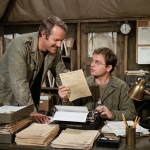
Radar pulled a crumpled slip of paper from his pocket—a telegraph flimsy, separate from the files.
His hand trembled as he extended it. “It just came in. It’s from… from Dr. Borelli.”
Hawkeye and B.J. both recoiled. Borelli, the brilliant, unorthodox doctor who had worked with them during the difficult arterial grafting training.
He was a symbol of innovation and connection to the world of *actual* medicine. A connection they missed with a physical ache.
Hawkeye took the slip of paper. His hand was steady, but his knuckles were white.
He read it in silence. Then he passed it to B.J., who read it just as quickly.
They looked at each other, their faces an mirror image of confusion, relief, and a strange, profound sadness.
The telegram read:
*TO PIERCE AND HUNNICUTT. 4077 MASH. REGRET TO INFORM YOU WE DID IT. CASE NO. 14 SUCCESSFULLY GRAFTED AND DISCHARGED TODAY. KNEW YOU WOULD CARE. BEST, BORELLI.*
“Did it?” B.J. said softly, his voice cracking. “It worked.”
Hawkeye walked back to his cot and sat down, his shoulders slumping. He rubbed his face, a gesture of absolute, marrow-deep exhaustion.
“They did it,” Hawkeye repeated, his voice barely a whisper. “Out of fourteen cases… fourteen failures that I… that I thought I carried…”
The message wasn’t a promotion or a reprimand. It was worse: it was a reminder of life.
It was news of a success, a surgical triumph, happening somewhere else, in a world that wasn’t covered in mud and constant triage.
Borelli hadn’t contacted them as colleagues; he had contacted them as surgeons who had shared a failure and needed to know that success was possible.
Radar still stood by the paperwork, watching them. He knew enough to stay quiet.
He saw the lines of pain that the good news had revealed on their faces.
Hawkeye’s wit, B.J.’s optimism—both were suddenly thin masks over the face of their profound homesickness and fatigue.
B.J. was the first to speak. He didn’t go back to his cot.
He went to the massive stack of paperwork, the pile that had symbolized all the bureaucracy they hated.
He placed his hand on the stack. “Did you bring this down, Radar, just so we would appreciate Borelli’s message?”
Radar swallowed. “Well, sirs… the Colonel has been riding me about the quarterly supply reports since Monday. And I knew… I saw the bottle. I figured, if you were… if you were happy… maybe you wouldn’t yell at me for bringing all of this tonight.”
Hawkeye let out a single, sharp laugh that was half a sob.
“So you used our brief happiness as a surgical shield against administrative assault. You are a brilliant, manipulative little corporal.”
He looked at the nervous young man, and the tenderness that always lay just beneath Hawkeye’s sarcasm rose to the surface.
“And you were right. We aren’t going to yell. In fact, if you can find one of those requisition forms for… say… ‘medical-grade bourbon, 10-year aged’… I might even sign it.”
A tiny, relieved smile finally appeared on Radar’s face. He knew the tension had broken.
Hawkeye walked over, grabbed his half-full metal cup, and handed it to the standing B.J.
He poured another for himself. Then, looking at the third man in the room, he picked up the bottle of bourbon and walked past the stack of paperwork to where Radar was standing.
He poured a generous shot into the metal cup that Radar hadn’t realized B.J. had handed him.
“This is not standard protocol,” Hawkeye said, his voice quiet.
“This violates every regulation from the Hague to the Department of the Army, and if Colonel Potter finds out, he’ll have us cleaning the latrines with toothbrushes.”
He raised his own cup. “But tonight… we’re drinking to a patient we never knew. To a success we didn’t perform. And to a friend who knew that we needed to hear that somewhere, someone is getting better.”
He looked from B.J. to the nervous young man holding the cup with both hands, his large stack of papers a monument of human effort against the impossible.
“To Case Number Fourteen,” Hawkeye said. “And to found family. Even if it is a messy, overworked, over-administrated family.”
They clicked their cups. Radar, holding the stack and the cup, looked between the two doctors, seeing not their titles, but his friends.
They drank in silence. It wasn’t the easy, raucous fun of their imaginary five-minute peace.
It was a quiet, shared moment of grace. A moment where the chaos outside, the paperwork mountain, and the war itself all fell silent, leaving only the warmth of friendship, the memory of medicine, and the fragile hope that sometimes, things really do work out.
Hawkeye put a hand on Radar’s shoulder, turning him around.
“Now, take that stack and put it where the sun don’t shine. Or, you know, the supply tent. And bring me my boots.”
The moment passed. The Swamp returned to being a tent in a warzone, but it was warmer than it had been before.
Sometimes, the best medicine is simply knowing you’re not alone.