❄️🛡️ NATO Launches “Arctic Sentry” Amid Rising Greenland Tensions
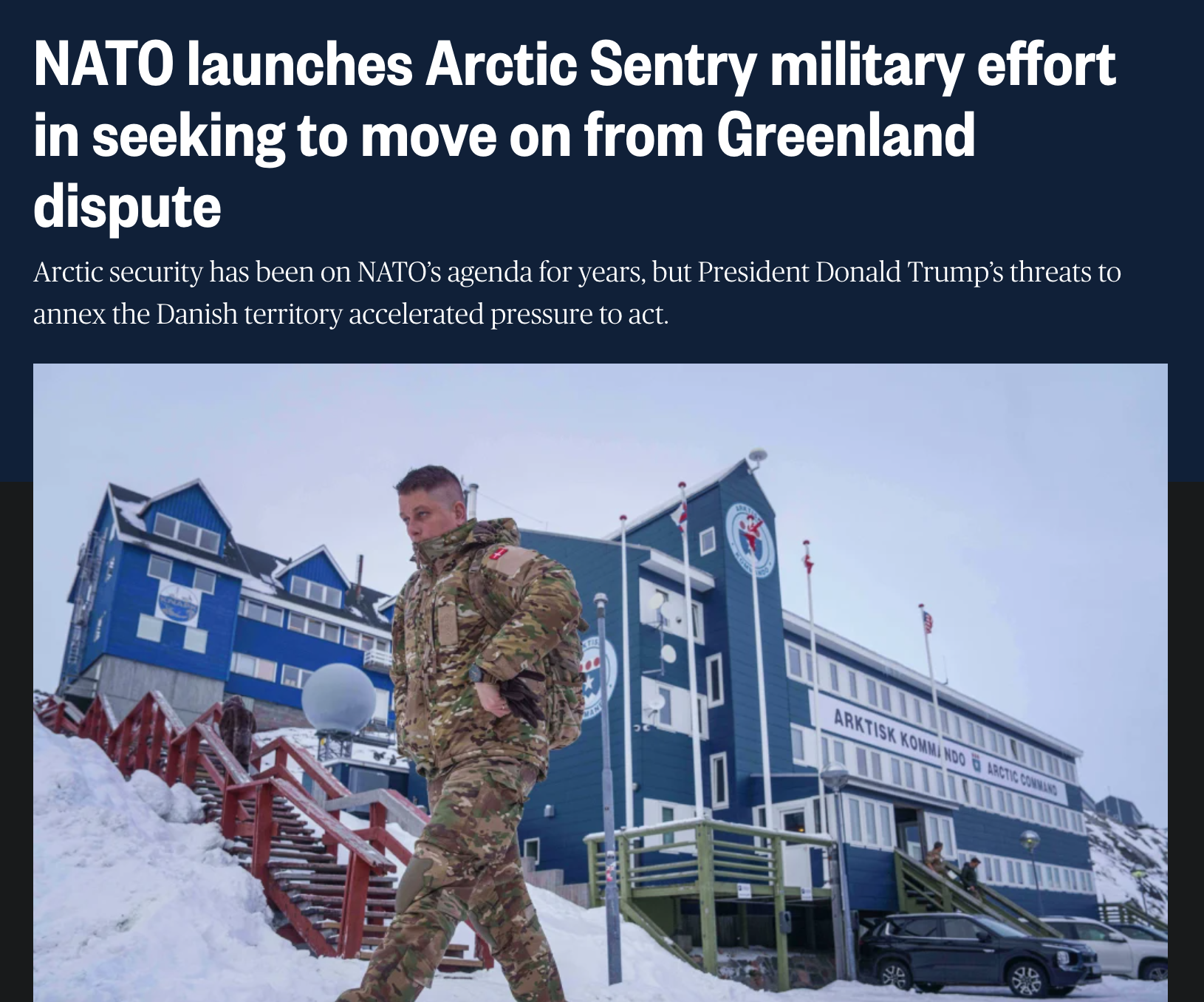
❄️🛡️ NATO Launches “Arctic Sentry” Amid Rising Greenland Tensions
In Brussels, the NATO announced Wednesday the creation of a new military coordination framework called Arctic Sentry, aimed at strengthening security cooperation in the High North.
The announcement comes just weeks after U.S. President Donald Trump escalated political tensions by renewing controversial remarks about potentially annexing Greenland, an Arctic territory of Denmark and a strategic NATO ally. 🌍
 🧊 What Is “Arctic Sentry”?
According to NATO officials, Arctic Sentry will initially function as a coordinated umbrella framework that brings together existing national military exercises under one strategic structure.
Rather than creating a new standing force, the initiative will:
-
🛡️ Coordinate national Arctic drills
-
📊 Improve intelligence-sharing
-
🔎 Identify regional security gaps
-
🤝 Strengthen allied interoperability
NATO Secretary-General Mark Rutte said this marks the first time the alliance will bring Arctic-related activities under a more unified command structure.
Importantly, Arctic Sentry is not a permanent troop deployment or a standalone military operation.
🇩🇰🇳🇴 Existing Arctic Exercises Integrated
The framework will initially incorporate major national drills, including:
-
Denmark’s Arctic Endurance
-
Norway’s Cold Response
These exercises have long tested cold-weather readiness and joint-force coordination in extreme Arctic conditions.
By aligning these operations under the Arctic Sentry label, NATO aims to create a more coherent and visible security posture in the region without dramatically increasing military presence.
🌐 Why the Arctic Matters More Than Ever
The Arctic has become an increasingly strategic region due to:
-
Melting ice opening new shipping routes 🚢
-
Untapped energy and mineral resources ⛽
-
Expanding military infrastructure 🛰️
-
Rising geopolitical competition
Rutte specifically cited Russia’s expanded military activity in the Arctic and China’s growing economic and strategic interest as major drivers behind NATO’s decision.
Russia has significantly upgraded Arctic bases and air defense systems in recent years, while China has declared itself a “near-Arctic state” and invested in polar research and infrastructure projects.
🇺🇸 Greenland Tensions Add Sensitivity
The launch of Arctic Sentry comes amid renewed debate over Greenland’s strategic importance. Trump’s past comments about acquiring Greenland — and recent rhetoric suggesting annexation — have drawn criticism in both Denmark and Greenland itself.
Although NATO officials did not directly link Arctic Sentry to the political controversy, the timing underscores the heightened sensitivity surrounding Arctic sovereignty and alliance unity.
Denmark, a founding NATO member, plays a key role in Arctic defense due to Greenland’s location between North America and Europe.
⚖️ Coordination, Not Escalation
NATO leaders emphasized that Arctic Sentry is designed to improve coordination — not escalate military tensions.
By centralizing oversight of Arctic activities, the alliance hopes to:
-
Reduce duplication of efforts
-
Strengthen rapid response capabilities
-
Enhance collective defense readiness
The initiative reflects NATO’s broader strategy of adapting to evolving security challenges while maintaining unity among allies.
🕊️ Conclusion: Arctic Security at a Crossroads
With geopolitical competition intensifying and climate change reshaping the region, Arctic security has become one of NATO’s most sensitive strategic priorities.
Arctic Sentry signals a new phase of coordination in the High North — one that seeks to balance deterrence with alliance cohesion.
As tensions surrounding Greenland and great-power competition continue, the Arctic is no longer a distant frontier — it is increasingly central to global security calculations. ❄️🌍