⛪🌍 Vatican Declines to Join Trump’s “Board of Peace,” Urges UN-Led Crisis Management
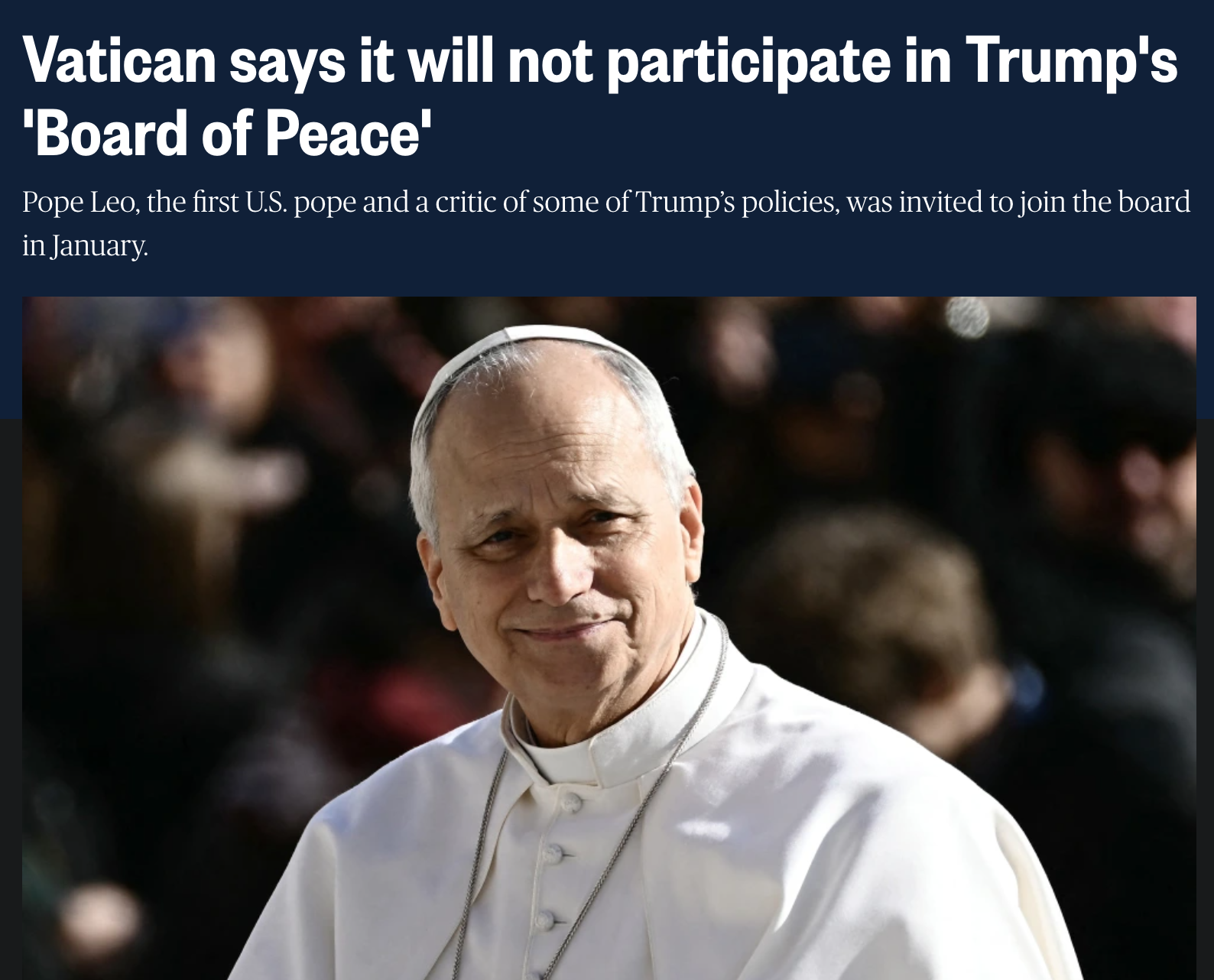
⛪🌍 Vatican Declines to Join Trump’s “Board of Peace,” Urges UN-Led Crisis Management
The Holy See has officially declined to participate in President Donald Trump’s proposed “Board of Peace,” reaffirming that international crisis management should remain under the authority of the United Nations.
Speaking Tuesday, Cardinal Pietro Parolin, the Vatican’s Secretary of State, confirmed that the Holy See will not take part in the initiative. He emphasized that the Vatican’s diplomatic stance differs from that of nation-states and that global peace efforts should be coordinated multilaterally through the United Nations system. ⚖️
 🕊️ Pope Leo’s Invitation and Vatican Position
Earlier this year, President Trump invited Pope Leo, described as the first U.S. pope and known for his critical views of certain Trump-era policies, to join the board.
However, the Vatican’s response makes clear that while it supports peacebuilding efforts globally, it does not see participation in this structure as aligned with its diplomatic principles.
Cardinal Parolin reiterated that the Holy See traditionally promotes dialogue, humanitarian action, and multilateral cooperation — particularly through established international institutions.
🌍 What Is the “Board of Peace”?
The proposed board was initially formed under Trump’s Gaza ceasefire plan, designed to oversee temporary governance in Gaza following hostilities.
Now, according to officials, the initiative is expanding its mandate to address broader global conflicts, signaling ambitions beyond the Middle East.
The first official meeting of the board is scheduled to take place in Washington on Thursday, where participants are expected to discuss Gaza’s reconstruction efforts and potential frameworks for post-conflict administration.
Supporters argue the initiative could offer a streamlined approach to peace oversight. Critics, however, question both its legitimacy and inclusiveness.
⚖️ Vatican Calls for UN Leadership
Cardinal Parolin underscored that crisis response and international governance efforts should be conducted through the United Nations, rather than through ad hoc coalitions.
The Vatican’s diplomatic tradition has long supported:
-
Multilateral negotiations
-
International humanitarian law
-
Inclusive political representation
-
UN-coordinated peacebuilding missions
By declining to join the Board of Peace, the Holy See signals its preference for established global frameworks rather than newly formed political structures led by individual governments.
🌐 Criticism Over Structure and Representation
The initiative has drawn scrutiny from human rights experts and international analysts.
Key criticisms include:
-
Concerns that the structure resembles a colonial-style governance model
-
The absence of a Palestinian representative
-
Questions about accountability and legal authority
Critics argue that sustainable peace requires inclusive representation from affected populations, particularly in Gaza, where local governance and reconstruction efforts will directly impact civilians.
Without Palestinian participation, some observers contend that the board risks lacking legitimacy in the eyes of those most affected.
📰 Broader Diplomatic Implications
The Vatican’s refusal adds another layer of complexity to international diplomacy surrounding Gaza and broader global conflicts.
The Holy See maintains a unique role in global affairs:
-
It is both a religious authority and a sovereign entity
-
It engages in humanitarian diplomacy
-
It often serves as a mediator in international disputes
By choosing not to participate, the Vatican reinforces its commitment to neutrality and multilateralism, while subtly distancing itself from unilateral political initiatives.
🕊️ Conclusion: Multilateralism vs. New Political Structures
The Vatican’s decision to decline participation in Trump’s “Board of Peace” highlights a fundamental debate in global governance: Should crisis management be handled by established international institutions like the United Nations, or by newly created coalitions led by individual states?
As the board prepares to meet in Washington to discuss Gaza’s reconstruction, international attention will focus on how the initiative evolves — and whether it can address concerns about legitimacy, representation, and global cooperation.
For now, the Holy See’s position is clear: international peace efforts should remain anchored within the United Nations framework. 🌍