❄️🏅 Ukraine Boycotts Officials Over Russian Participation at Winter Paralympics
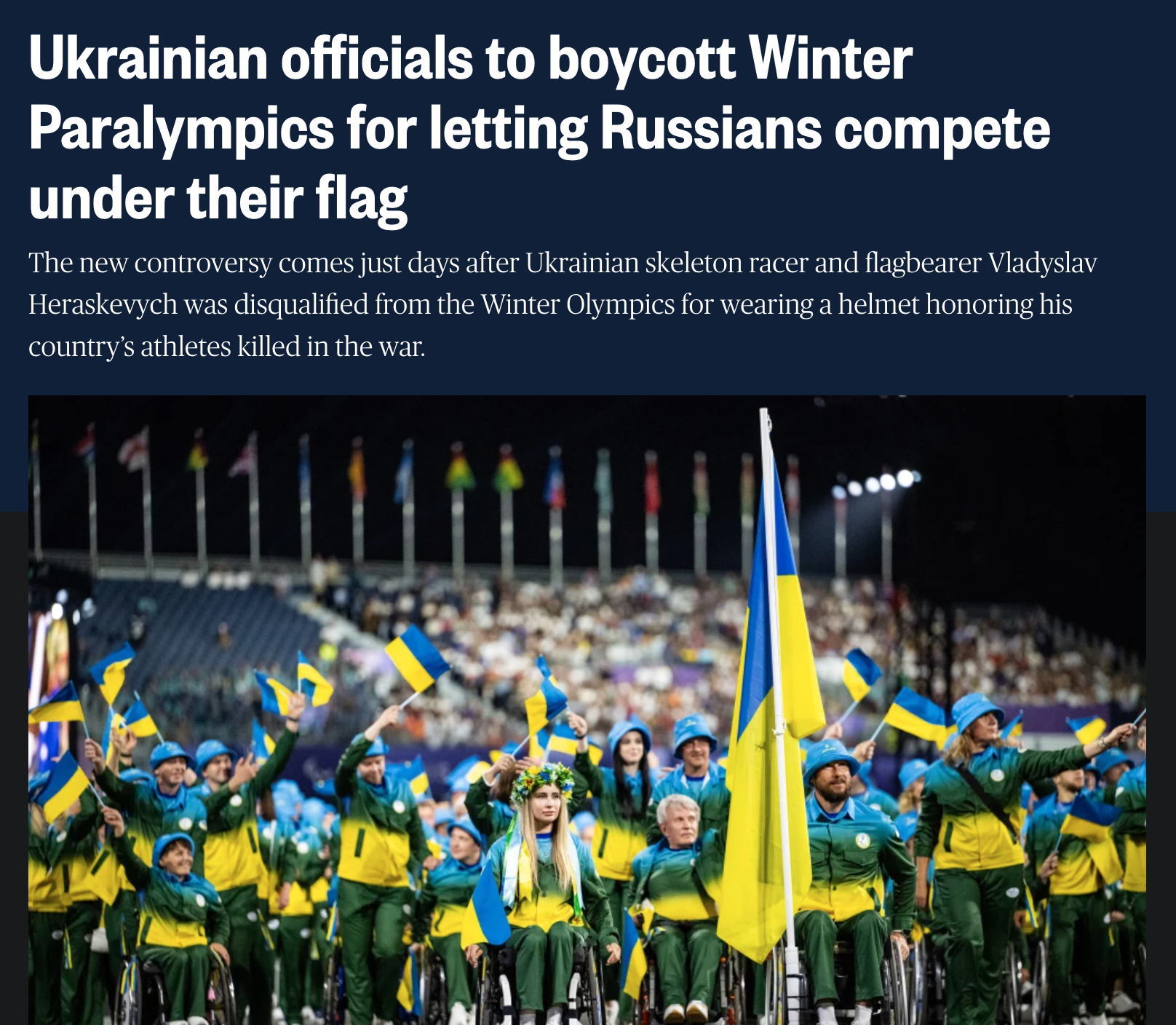
❄️🏅 Ukraine Boycotts Officials Over Russian Participation at Winter Paralympics
Ukraine has announced that its government officials will not attend the upcoming Winter Paralympics, citing objections to the decision allowing Russian and Belarusian athletes to compete under their national flags. 🇺🇦 The move underscores the continued political and diplomatic tensions surrounding international sporting events amid the broader Russia–Ukraine conflict.
Despite the boycott of officials, Ukrainian athletes will still compete, reaffirming the country’s commitment to supporting its Paralympic competitors on the global stage.
 🇮🇹 Milan Cortina 2026 Winter Paralympics: Key Details
The upcoming Winter Paralympics — officially known as the 2026 Winter Paralympics — will take place from March 6 to March 15 in northern Italy as part of the broader Milan-Cortina sporting program.
According to Ukraine’s Sports Minister Matvii Bidnyi, while Ukrainian athletes will proudly participate in the Games, no Ukrainian government delegation will attend in protest of the participation rules.
This dual approach signals Ukraine’s attempt to balance support for its athletes with a firm political stance against Russia and Belarus.
🏳️ IPC Confirms Russian and Belarusian Participation
The International Paralympic Committee (IPC) confirmed that 10 Para athletes from Russia and Belarus will compete under their respective national flags at the Games.
This marks a significant departure from policies adopted in other international competitions since Russia’s full-scale invasion of Ukraine. For Kyiv, allowing national flags and symbols at a major global sporting event sends a troubling political message.
The IPC has defended its position by emphasizing the importance of inclusivity and athletes’ rights, arguing that competitors should not be automatically excluded based on nationality.
🏅 IOC Policy Differs on Neutral Athletes
The IPC’s decision contrasts sharply with the stance of the International Olympic Committee (IOC), which has permitted Russian and Belarusian athletes to participate in Olympic events only as neutral athletes.
Under IOC guidelines, these competitors:
-
Cannot compete under their national flag 🇷🇺🇧🇾
-
Cannot display national colors
-
Cannot have their national anthem played
-
Must compete as individuals without official state representation
The difference in policy highlights a lack of unified governance standards across major global sporting bodies, further complicating the geopolitical landscape of international athletics.
⚖️ Politics and Sport: A Continuing Tension
Ukraine’s decision to boycott officials reflects the broader debate over whether sports should remain politically neutral or serve as a platform for moral and diplomatic positioning.
Since the outbreak of war, international sports federations have struggled to balance:
-
Athlete rights
-
International law and sanctions
-
Public opinion
-
The principle of political neutrality in sport
For Ukraine, the presence of Russian and Belarusian national symbols at a major global event is viewed as incompatible with ongoing hostilities and unresolved conflict.
🇺🇦 Ukrainian Athletes Remain Focused
Despite political tensions, Ukrainian Paralympians will compete in Milan Cortina, demonstrating resilience and determination.
Ukraine has historically performed strongly at Winter Paralympic events, often ranking among the top medal-winning nations. The athletes’ participation ensures that Ukrainian representation on the world stage remains visible, even as official diplomatic attendance is withdrawn.
🌍 Global Impact and What Comes Next
The controversy surrounding the Winter Paralympics is part of a wider conversation about the role of sport during times of war.
Key questions remain:
-
Should athletes be separated from political actions of their governments?
-
Does allowing national representation equate to political endorsement?
-
Can global sports bodies maintain consistency across competitions?
As the March Games approach, international attention will focus not only on athletic achievement but also on how global sporting institutions navigate ongoing geopolitical tensions.
🕊️ Conclusion: Sport at the Crossroads of Diplomacy
Ukraine’s boycott of officials at the 2026 Winter Paralympics highlights the enduring intersection between politics and international sport. While athletes from Ukraine will compete with pride, the absence of government representatives sends a clear diplomatic message.
With differing policies between the IPC and IOC, the debate over neutrality, representation, and accountability in global sports is far from settled.
As the Milan Cortina Games begin in March, the world will once again witness how sport reflects — and sometimes intensifies — the political realities beyond the arena. ❄️🏅