🔬🇺🇸 Science Funding Survives After a Year of Turbulence
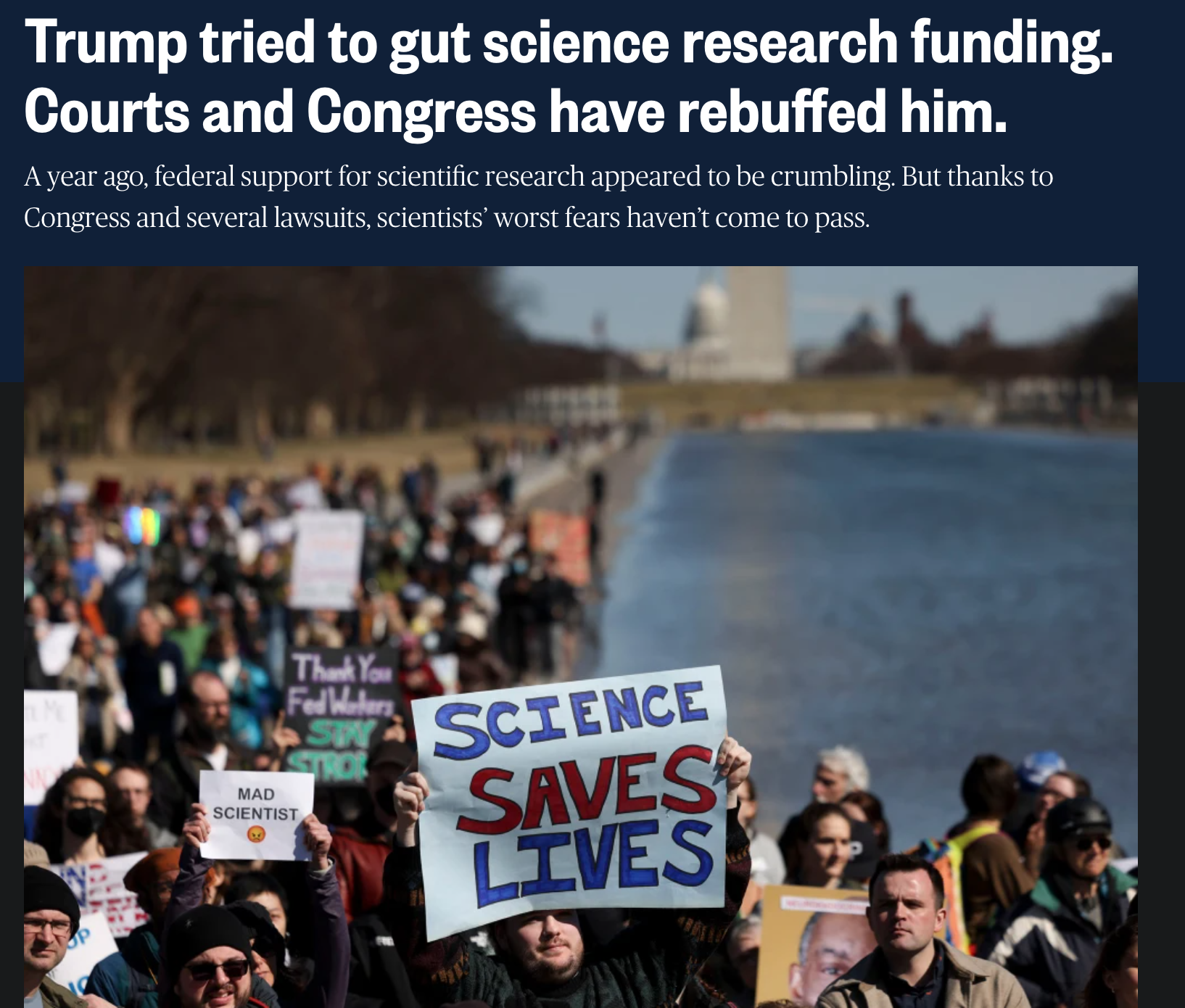
🔬🇺🇸 Science Funding Survives After a Year of Turbulence
Federal science funding in the United States has weathered a year of political upheaval, budget battles, and legal fights — emerging largely intact despite early fears of sweeping cuts. 🇺🇸
Last February, the Donald Trump administration cut thousands of jobs at federal science agencies, restricted university grant funding, and proposed reducing research overhead costs.
In the months that followed, the administration:
-
Targeted elite universities over antisemitism allegations 🎓
-
Pulled back grants tied to diversity, equity, and inclusion (DEI) initiatives
-
Proposed deep budget reductions for agencies such as NASA and the National Science Foundation (NSF)
For many researchers, it appeared that the long-standing federal–university research partnership was under serious strain.
🗣️ Holden Thorp, editor of the Science family of journals, described the proposed cuts as a “betrayal” and an “unforeseen and immediate hit” to American innovation.
 ⚖️ Courts and Congress Push Back
One year later, however, the most severe fears have not materialized.
Legal challenges from organizations including:
-
American Civil Liberties Union (ACLU)
-
American Public Health Association (APHA)
-
Association of American Universities (AAU)
have blocked several major policy changes, preserving billions of dollars in research funding. ⚖️
Meanwhile, Congress rejected many of the administration’s most aggressive proposed cuts. Recent appropriations packages keep science agency budgets roughly flat compared to the previous year.
🏛️ This week, the House joined the Senate in approving a funding bill that includes a modest increase for the National Institutes of Health (NIH) — rejecting a request to slash its budget by more than 40%. The president signed the bill Tuesday night.
📌 What It Means for U.S. Research
For now, the federal science funding system remains intact, maintaining support for medical research, space exploration, and technological innovation.
Still, tensions over long-term funding priorities, university oversight, and the balance between political accountability and scientific independence continue to shape debate in Washington.
The year’s turbulence underscores how central science policy has become to broader political and cultural battles — even as bipartisan support for research funding proves resilient.