The Mess Tent Truce
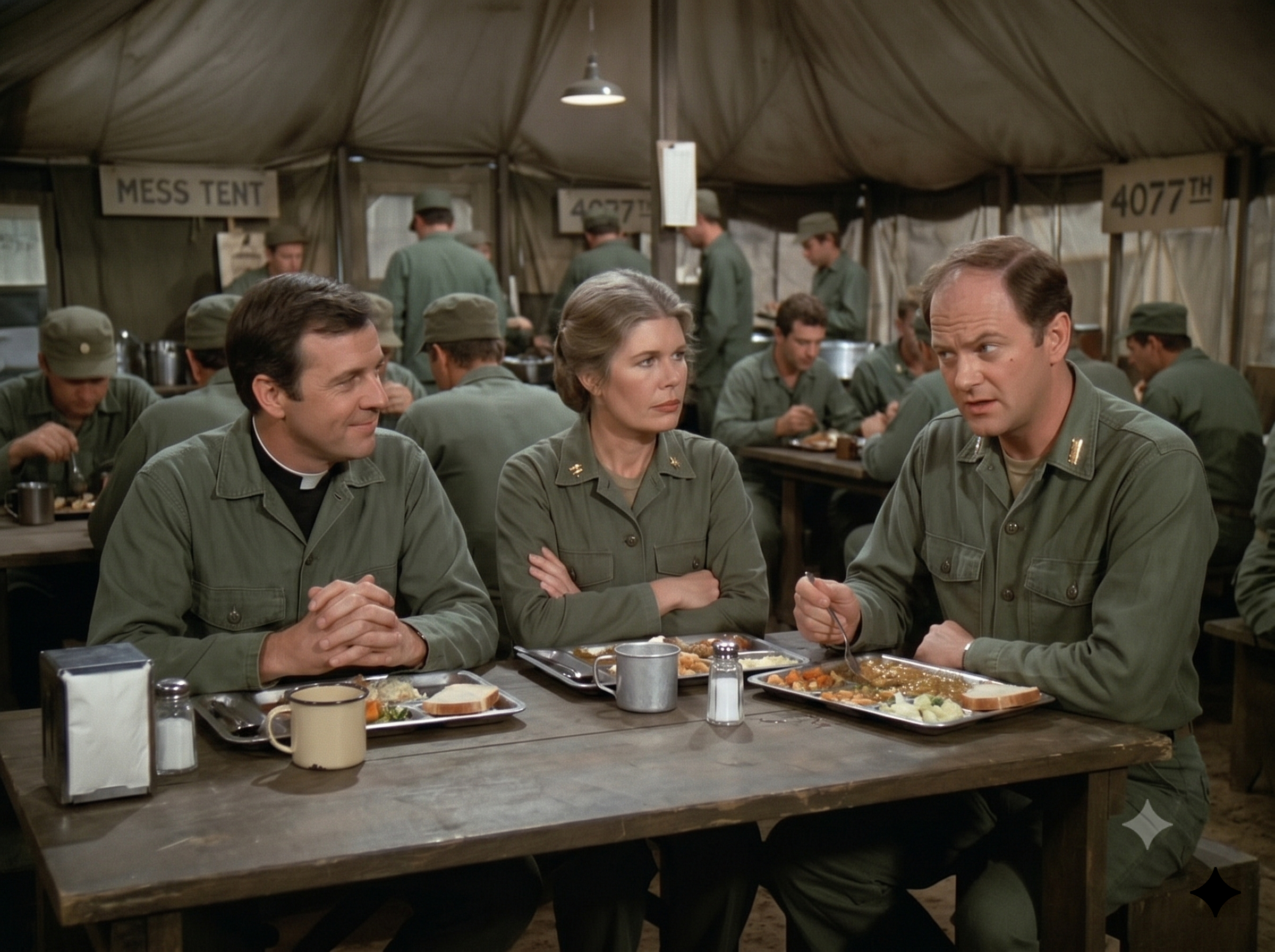
The mess tent of the 4077th Mobile Army Surgical Hospital was never a place of comfort, but on a damp, gray Tuesday afternoon, it felt like a particular kind of purgatory.
The air was thick with the smell of wet canvas, stale coffee, and whatever mystery meat Igor was proudly serving from his lukewarm vats.
The background hum was a low, tired drone of nurses and surgeons who had just survived a grueling eighteen-hour marathon in the operating room.
Nobody was talking about going home anymore; they were just talking about surviving until the next pot of coffee was brewed.
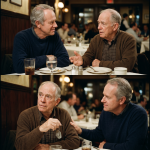
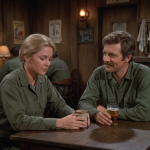
Sitting at one of the long, dull beige tables were three people who had entirely different ways of processing their exhaustion.
On the left sat Father John Mulcahy, his hands resting gently near his tin coffee cup, an anchor of quiet grace in a sea of olive drab.
In the center sat Major Margaret Houlihan. Her arms were folded so tightly across her chest that her knuckles were white.
Her posture was rigid, her spine perfectly straight, and her eyes were fixed somewhere in the middle distance, desperately trying to maintain her dignity in a room that smelled like boiled boot leather.
To her right sat Major Charles Emerson Winchester III.
Unlike the rest of the camp, who mostly slumped over their trays in defeat, Charles sat with upright, aristocratic posture.
He held his fork with a delicate, two-fingered grip, inspecting the gelatinous brown mound on his dull metal tray as if he were a diamond merchant examining a flawed gemstone.
“I ask you,” Charles announced to the table, his voice dripping with refined irritation. “Is there a Geneva Convention protocol against whatever this is? Because if there isn’t, I intend to draft one myself.”
He leaned slightly toward Margaret, raising a single, judgmental eyebrow.
“Look at it, Margaret. It lacks the structural integrity to be called a solid, yet it lacks the fluidity to be classified as a liquid. It exists in a state of culinary limbo. I suspect if I were to leave it in the sun, it would not spoil, but rather evolve into a new, hostile form of life.”
Margaret did not blink. She did not unfold her arms.
She was running on two hours of sleep, her feet were aching with a deep, pulsing throb, and she was trying very hard not to think about the young corporal from Iowa she had just spent four hours helping to patch back together.
She needed silence. She needed just five minutes of absolute, unbroken peace.
But Charles was on a roll, completely oblivious to the dangerous tightening of her jaw.
“And the carrots,” Charles continued, poking at a sad, orange cube with the tine of his fork. “I use the term ‘carrot’ purely in the historical sense. These are the ghosts of carrots. These are vegetables that have suffered a great trauma and have given up the will to live.”
Father Mulcahy watched the two of them with a soft, knowing smile.
He understood the camp’s delicate ecosystem better than anyone. He knew that Charles’s complaints were his armor, a way to build a wall of superiority against the senseless horror of the war outside the compound.
But Mulcahy also saw the dangerous stillness in Margaret.
“Perhaps it’s best if we just consider it fuel, Charles,” Mulcahy offered gently, his voice a soothing balm. “The Lord provides sustenance in mysterious ways.”
“With all due respect, Father,” Charles scoffed, dropping his fork onto the metal tray with a sharp clatter, “the Lord had absolutely nothing to do with this. This is the work of Igor, and frankly, I suspect he is employed by the enemy.”
He turned fully toward Margaret now, demanding her participation in his misery. “Tell me you aren’t going to subject your digestive tract to this, Margaret. Tell me you have higher standards.”
Margaret squeezed her arms tighter. The noise of the mess tent seemed to suddenly amplify.
The clinking of tin cups, the scrape of benches, the endless, droning complaints of Winchester—it all swirled together into a deafening roar in her head.
“Charles,” she whispered, her voice dangerously thin.
“I mean, we are officers,” Charles pushed on, completely missing the warning sign. “We shouldn’t have to tolerate…”
“I said, Charles!” Margaret’s voice suddenly cracked like a whip.
She slammed her hands down flat onto the beige tabletop. Her metal tray jumped. The salt and pepper shakers rattled against the dull tin.
The immediate vicinity of the mess tent went dead silent.
Margaret turned to face him, her eyes blazing, her chest heaving, and a look of absolute, fragile devastation threatening to break through her iron composure.
Charles froze.
The pompous, theatrical indignation drained from his face instantly, replaced by a look of startled caution.
He had expected her usual sharp retort. He had expected her to snap back, to quote army regulations, or to defend the terrible food just to spite him.
He had not expected her eyes to be welling with unshed, furious tears.
“Just… stop,” Margaret said. Her voice was no longer a shout, but a strained, breathless whisper that carried more weight than any scream.
She didn’t cross her arms again. She let her hands rest heavily on the table, trembling slightly.
“Just for one minute, Charles. Stop complaining. Stop dissecting the food. Stop talking about Boston, and restaurants, and proper dining. Just… stop talking.”
She looked down at her own untouched tray, blinking hard to keep the moisture from spilling over her lashes.
“I held retractors for six hours today,” she said, the words slipping out as if she couldn’t hold them back anymore. “I watched three boys who aren’t old enough to buy a beer get carried out to post-op, and I don’t know if two of them are going to make it through the night. I am so tired I can’t feel my hands.”
She looked back up at him, her defenses stripped away, revealing the raw, exhausted woman underneath the brass and the discipline.
“I don’t care about the carrots, Charles. I just want to sit here in the quiet and pretend, just for five minutes, that the rest of the world doesn’t exist. Can you give me that? Can you just give me five minutes of peace?”
The silence that hung between them was heavy and sudden.
At the other tables, the murmur of the camp slowly resumed, but their small corner of the tent remained suspended in a delicate, fragile quiet.
Father Mulcahy did not intervene with a sermon. He didn’t offer a platitude.
Instead, he simply reached out and rested his hand lightly over Margaret’s trembling fingers on the tabletop. It was a gesture of profound, silent understanding.
A gentle reminder that she was not alone in the dark.
Charles sat perfectly still.
The haughty Boston aristocrat was gone, replaced by the brilliant, weary surgeon who had stood at the table next to hers for those same agonizing eighteen hours.
He looked at her, truly looked at her, and saw the deep, bruised shadows under her eyes that mirrored his own.
He slowly pulled his gaze away from her and looked down at his tray.
For a long moment, the only sound was the distant drone of a jeep engine outside the canvas walls.
Then, with deliberate, quiet movements, Charles reached into the deep pocket of his green fatigue jacket.
He withdrew a small, pristine, silver-wrapped square. It was a piece of imported dark chocolate, undoubtedly mailed to him from his sister Honoria, hoarded and protected against the damp and the rats of Korea.
It was the kind of treasure Charles usually savored alone, in the privacy of the Swamp, with a glass of smuggled brandy.
Without a word, he slid the silver square across the beige table.
It stopped right next to Margaret’s tin coffee cup.
Margaret stared at the small silver package. She blinked, a single tear finally escaping and tracking down her cheek, which she quickly brushed away.
She looked up at Charles, her expression a complex mixture of surprise, gratitude, and lingering exhaustion.
Charles did not look at her. He picked up his coffee cup, staring straight ahead.
“It is… barbaric,” Charles said quietly. His voice was stripped of all its usual theatrical flair. It was just low, honest, and profoundly tired. “All of it. It is entirely barbaric, Margaret.”
He took a slow sip of the terrible coffee, grimacing slightly, but he didn’t complain.
“Eat the chocolate,” he added softly, his tone almost gentle. “It will pair terribly with Igor’s coffee, but it is infinitely better than the carrots.”
Margaret looked down at the chocolate, and a tiny, almost imperceptible smile broke through the tension in her jaw.
It wasn’t a joke, and it wasn’t an apology. It was something better. It was solidarity. It was the quiet acknowledgment that they were all trapped in the same nightmare, holding each other together with whatever small scraps of humanity they had left.
Father Mulcahy’s soft smile deepened.
He withdrew his hand from Margaret’s, picking up his own cup. He looked between the two majors, his heart swelling with a quiet, paternal pride for the flawed, beautiful people of his flock.
“It is a small mercy,” Mulcahy said gently, his eyes twinkling just a bit. “But in this place, I find we must count every single one.”
Margaret slowly reached out and picked up the silver square.
She didn’t say thank you. She didn’t need to. In the 4077th, gratitude was rarely spoken aloud; it was lived in the quiet moments between the sirens.
She carefully peeled back the foil, broke off a small piece, and put it in her mouth.
For the first time all day, her shoulders dropped from their rigid posture. She let out a long, shaky breath, the tension finally leaving her spine.
The three of them sat together in the drafty canvas tent, surrounded by the clatter and the grime of the war.
They didn’t speak again for a long time. They just sat side by side, sharing the terrible coffee, the dull metal trays, and the profound, unbreakable comfort of each other’s company.
In the end, it wasn’t the food that kept them alive, but the quiet strength they found in the people sitting right across the table.