The Midnight Requisition: A Quiet Corner of the War
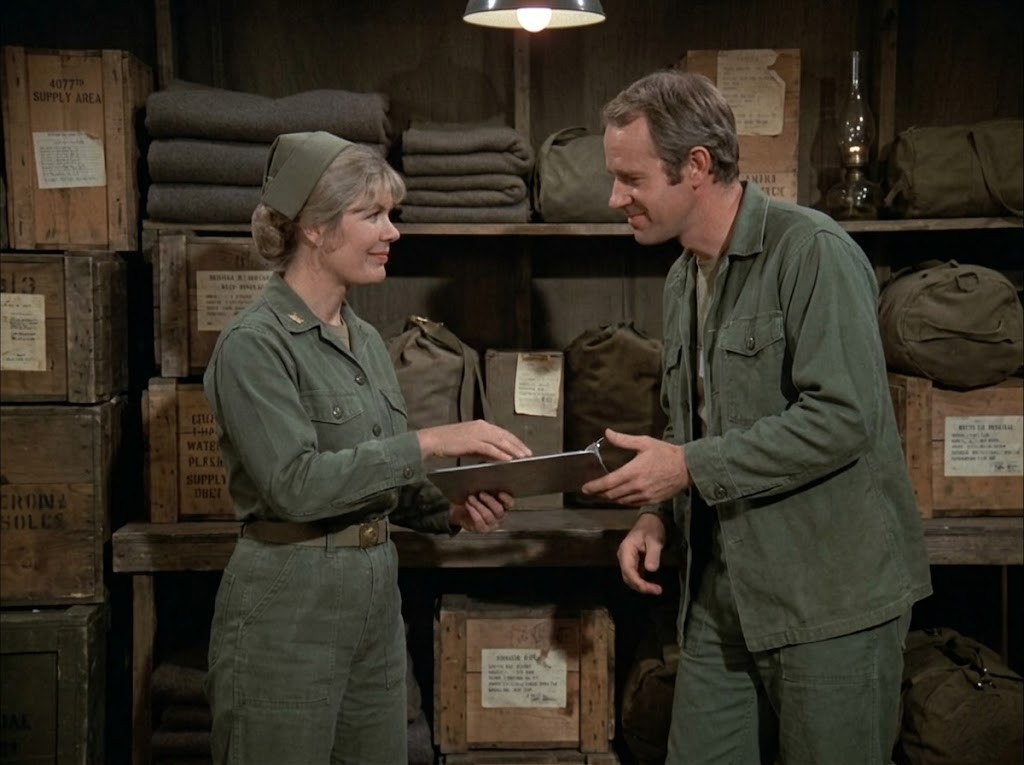
The war didn’t stop at the canvas flap of the supply tent, but it did have the decency to lower its voice.
Outside, the 4077th M*A*S*H was wrapped in the cold, unforgiving dark of a Korean night. The chopper pads were finally silent. The harsh glare of the operating room lights had been switched off, leaving behind the heavy, lingering scent of antiseptic and exhaustion.
Inside the supply tent, the air smelled differently. It smelled of damp canvas, pine wood, and the scratchy, mothballed scent of olive-drab wool.
It was 0300 hours, and Major Margaret Houlihan was looking for something she could control.
She stood beneath the pale yellow glow of a solitary, swinging lightbulb. All around her were the neat, logical stacks of military bureaucracy. Wooden crates stamped with bold black letters: *4077th SUPPLY AREA*. Duffel bags lined up with mathematical precision.
In a world that had spent the last thirty-six hours tearing itself apart in the OR, this dusty storage room was Margaret’s sanctuary of order.
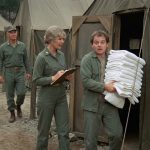
She held a heavy aluminum clipboard against her chest like a shield. She was doing inventory. She didn’t need to do inventory. The clerks could have done it in the morning. But her hands were still shaking slightly from the adrenaline of a marathon surgical shift, and counting blankets was the only way she knew how to calm them down.
“You know, Major,” a soft, tired voice drifted from the doorway. “If you count those blankets any harder, they’re going to surrender.”
Margaret stiffened, her spine snapping into its default military posture. She turned to see Captain B.J. Hunnicutt leaning against a stack of crates.
He looked terrible, which meant he looked exactly like the rest of them. His green fatigues were rumpled, his collar was unbuttoned, and there were dark, bruised shadows beneath his kind eyes.
“Captain Hunnicutt,” Margaret said, her voice carrying a brittle edge. “If you and Pierce are looking for a place to hide your latest shipment of bootleg gin, you have the wrong tent.”
B.J. smiled, a slow, gentle expression that crinkled the corners of his eyes. He pushed himself off the crates and walked slowly into the center of the room.
“Hawkeye is currently snoring loud enough to wake the Chinese army,” B.J. said quietly. “I just came in here to find a new toothbrush and maybe a few minutes of peace.”
Margaret didn’t drop her guard. She clicked her pen, her eyes darting back to the official manifest. “Well, find your toothbrush and move along, Captain. Some of us are trying to maintain a functioning hospital.”
“You’re counting gauze pads at three in the morning, Margaret,” B.J. pointed out, his voice entirely devoid of sarcasm.
“Someone has to,” she snapped, gripping the clipboard tighter. “If I leave it to the quartermaster, we’ll end up with a shipment of left-handed surgical gloves and no penicillin. The nurses need to know exactly what we have on hand. It is a matter of discipline.”
B.J. didn’t argue. He just stood near her, looking at the neat stacks of supplies, and then looking back at her. He could see the sheer, bone-deep fatigue radiating from her shoulders. He knew she had skipped mess call twice today. He knew she had stood at the table next to his for twelve hours straight, handing instruments with flawless precision.
He took a step closer. He didn’t reach for her, but he reached out toward the space between them.
“Let me see the board,” B.J. said softly.
“I am perfectly capable of reading a supply manifest, Captain,” Margaret replied, lifting her chin.
“I know you are,” B.J. said. He reached out and gently took hold of the bottom edge of the metal clipboard.
Margaret didn’t let go. For a long, tense second, they stood there in the dim light, engaged in a quiet, stubborn tug-of-war over a piece of aluminum. The camp’s head nurse and one of its best surgeons, fighting a silent battle in the middle of the night.
“Margaret,” B.J. said, his voice dropping to a low, steady timber. “Look at the paper.”
She frowned, keeping her grip tight. She looked down at the manifest, ready to point out exactly where she had correctly tallied the winter issue long johns.
But as her eyes focused on the bottom of the page, her breath hitched in her throat. The official Army requisition form had been altered.
Right below the line for ‘Blankets, Wool, O.D.’, someone had added a new, handwritten entry in dark pencil.
It wasn’t a supply error. It was an impossible order.
Margaret stared at the neat, block lettering penciled onto the bottom of her official form.
She blinked, her tired eyes trying to make sense of the words. She traced the graphite letters with her gaze, realizing that the handwriting wasn’t Potter’s. It was B.J.’s.
“Captain,” Margaret started, her voice faltering slightly. The rigid, defensive tone was gone, replaced by a sudden, shaky vulnerability. “What is this?”
B.J. kept his hand on the bottom of the clipboard, resting his weight against the edge of a wooden crate. He didn’t pull the board away from her. He just shared the weight of it.
“It’s an official requisition, Major,” B.J. said warmly. “Signed, sealed, and approved by the commanding officer. I asked Colonel Potter for it about twenty minutes ago. He practically threw the pen at me to get it done.”
Margaret shook her head, a familiar wave of stubborn duty rising back to the surface. “I can’t take a twelve-hour pass. The post-op ward is full. Nurse Kellye is exhausted, and Able is practically asleep on her feet. If I don’t supervise the morning shift—”
“If you don’t supervise the morning shift,” B.J. interrupted gently, “Kellye and Able will handle it perfectly. Do you know why?”
Margaret looked up at him, her brow furrowed. “Why?”
“Because they learned from the best,” B.J. said simply.
The words hung in the quiet air of the supply tent. The faint hiss of the gasoline lantern seemed to fill the silence.
Margaret looked at B.J.’s face. There was no teasing in his eyes. There was no Hawkeye-style punchline waiting to drop. There was only absolute sincerity, profound respect, and the deep, unspoken bond of two people who had seen too much blood and shared too much mud.
“Margaret,” B.J. continued, his tone softening even further. “You mother this entire camp. You hold the nurses together, you keep the brass off our backs, and you make sure every wounded kid who comes through those doors gets the absolute best care the Army can’t afford.”
He tapped a finger against the aluminum board.
“But you can’t pour from an empty canteen. Even Peg knows when to put the broom down and let the house get a little dusty.”
Margaret stared at him. The comparison to his beloved wife, the woman he spoke of with such reverence and longing, struck a chord deep inside her chest.
She had spent so many years in the Army building walls. Building an armor of regulations, protocols, and sharp reprimands just to survive in a man’s world. She was used to fighting for every ounce of respect she received.
She wasn’t used to someone just handing it to her. She wasn’t used to someone looking past the brass oak leaf on her collar and seeing the exhausted human being underneath.
A warm, heavy lump formed in Margaret’s throat. She looked back down at the clipboard.
She realized that B.J. had come into the supply tent specifically to find her. He hadn’t been looking for a toothbrush. He had been looking for a friend who was pushing herself too hard.
Slowly, the tension began to drain from Margaret’s shoulders. The rigid military posture she had maintained all night finally gave way.
She looked up at B.J., and a smile broke across her face. It wasn’t her polite, official smile. It was a genuine, radiant, and incredibly warm expression. It reached her tired eyes and lit up the dusty, dim room.
B.J. smiled back, a broad, affectionate grin that carried all the warmth of a California afternoon.
They stood there for a long moment, simply looking at each other, still holding the clipboard between them. It was a bridge of shared humanity. A quiet acknowledgment that they were far from home, trapped in a nightmare, but they were not alone. They were family.
“Twelve hours, Captain?” Margaret asked, her voice soft and slightly teasing. “Are you sure the Swamp won’t burn the camp down in that time?”
“I make no promises,” B.J. chuckled, letting go of his side of the clipboard. “But I’ll personally guard the nurses’ tent from any stray surgeons. You have my word as a gentleman and a doctor.”
Margaret looked at the penciled order one last time. She didn’t erase it. Instead, she unclipped her pen and, with a swift, decisive motion, initialed the bottom of the page.
“Requisition accepted, Captain,” she said quietly.
She lowered the clipboard to her side. Suddenly, the wool blankets just looked like blankets again. The overwhelming need to count them, to control them, was gone. She was just tired. A good, honest kind of tired.
“Come on, Major,” B.J. said, gesturing toward the canvas flap that led out into the compound. “Let’s get you back to your tent. The war will still be here tomorrow. Unfortunately.”
Margaret nodded. She turned off the solitary lightbulb, plunging the neat stacks of wooden crates into darkness.
As they stepped out of the supply tent together, the icy Korean wind hit them, carrying the distant, low rumble of artillery. But for tonight, the cold didn’t seem to bite quite as hard.
Margaret pulled her jacket tight, walking back to her quarters with a lighter step, carrying the clipboard not as a shield, but as a reminder of the best thing the Army had ever issued her: a friend.
In a place defined by what was lost, their greatest inventory was always each other.