The Fine Line Between Hope and Forms
You didn’t just *have* hope in Korea. You ordered it. It was listed right there, under “H” on the supply forms, somewhere between “Hand Grenade” and “Hardtack.”
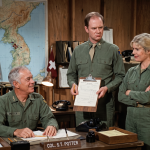
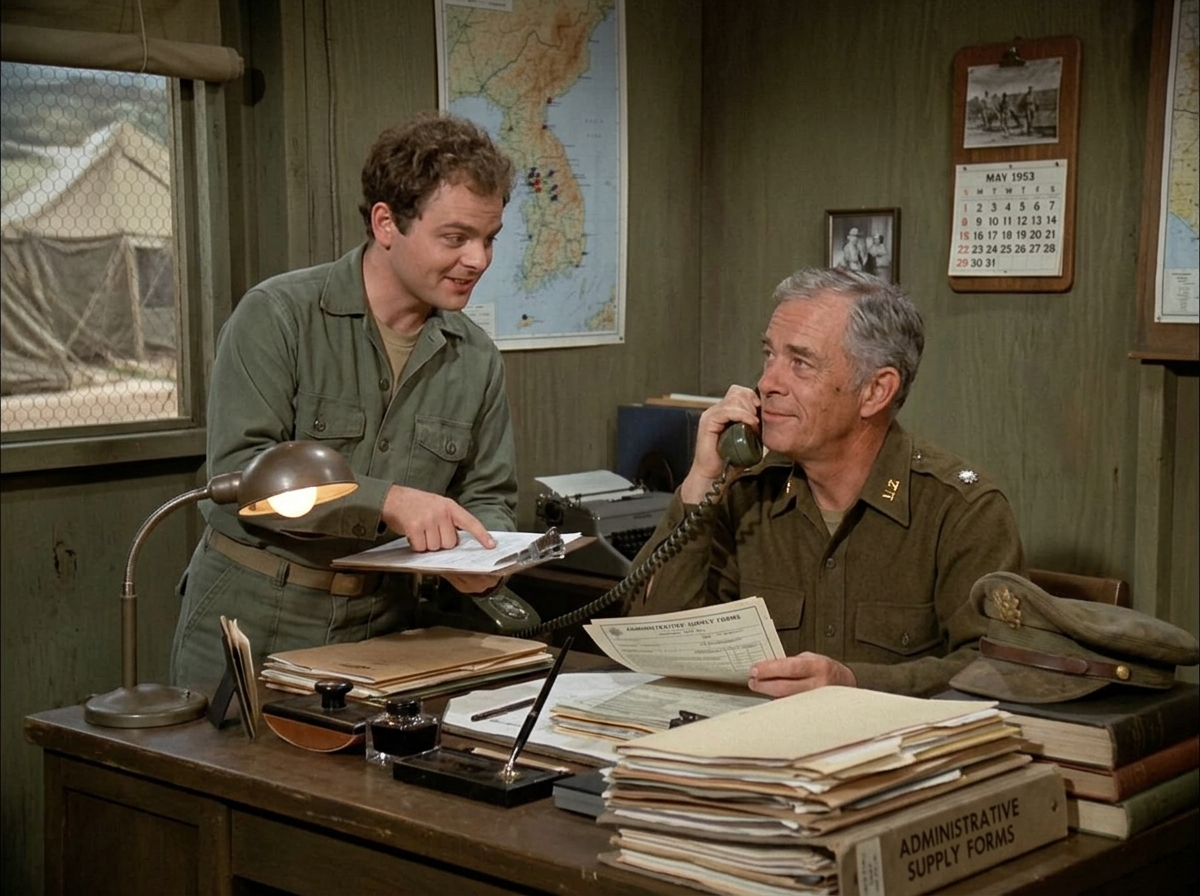
Colonel Sherman Potter sat at his heavy wooden desk, in the center of image_0.png, surrounded by the usual bureaucratic ramparts. His left hand, steady as an anchor, held the black receiver of the field phone.
The calendar behind him clearly said May 1953. To anyone else, it was just another month of mud and incoming casualties. But to Radar and the Colonel, it was a month where some very specific, unofficial promises were kept.
They both knew the call was coming.
Potter listened, a quiet, knowing smile just beginning to show around the edges of his face. He nodded slowly, saying “Aha… Yes, Colonel. Understand. That is… standard protocol.”
He glanced up at Radar.
Corporal Walter O’Reilly—Radar to everyone, including himself—stepped into image_0.png from the shadows. His face was a mirror of earnest worry, eyes wide behind his round glasses, peering with an almost comical amount of concern. He clutched a clipboard, holding it tightly as if it were a shield against the bad news.
He had heard the beginning of the call. The silence on his end was absolute, his anxiety practically buzzing in the air, creating a visible tension that mirrored his position in the frame.
He needed the Colonel to say it.
With a final, “Thank you, Colonel. Good talk,” Potter carefully replaced the receiver.
Radar took a half-step forward, the clipboard held out like an offering, his finger hovering over the top page, his gaze locked intensely on the Colonel’s.
“Sir?” Radar whispered. “Did… did the shipment make the cut?”
Colonel Potter picked up a single sheet of paper from the stack in image_0.png, staring at it with deliberate calm. His eyes were crinkling. His voice was too steady.
“Radar,” he began, and the way he said his name was enough to make Radar’s breath catch. “We’ve got a problem with the 134-B.”
The tension in Radar’s face broke, his smile faltering as he prepared for disappointment. “Problem, sir? But the Colonel… you just… on the phone…”
“It’s the phrasing, Son,” Potter said, letting out a soft sigh that didn’t quite reach his eyes. “Supply says ‘Urgent: Personnel Sustenance Item – Unit Moral Booster.’ But *his* forms,” he tapped the paper with the end of his pen, “just list it as ‘B-Grade Livestock Consumable, Perishable.’”
The silence between them stretched, thick and painful. Radar, whose expression in image_0.png was caught between hope and devastation, finally broke it.
“Did they approve the… did they approve the corn, Colonel?” his voice small.
It had taken Radar months to source it. Not canned corn. Not the mush from the mess tent. Real, sweet corn from the states. Specifically, from a farmer near Ottumwa, Iowa, who claimed his crops tasted like Sunday dinner. It was a secret operation, involving dozens of trade-offs, three distinct bribes to clerks in Tokyo, and at least one favor owed to a General in Seoul.
Radar had sold it to Colonel Potter as a crucial part of maintaining psychological readiness for the surgeons. A little taste of home to make the next endless rotation more bearable.
But the bureaucracy of war only cared about form numbers. Not home.
Potter carefully removed his glasses and set them on the stack of forms. He stood up, slowly, the old cavalry officer.
He walked around the heavy desk and rested his hand firmly on Radar’s shoulder. Radar looked up, his face an open book of crushing disappointment, yet still trying to stay professional, as seen in his position in image_0.png.
“The form is technically invalid, Son,” Potter said, his voice dropping into a quiet, warm rumble. “Total supply snaffle. Mismanaged paperwork.”
He squeezed Radar’s shoulder.
“However,” Potter continued, the mischievous crinkle returning to his eyes, “Supply Colonel Henderson was very emphatic. He told me, ‘Sherman, if you don’t receive this 134-B, you will be in gross violation of my standard protocol to not have good corn and potato salad in your unit.’ It seems he understood that ‘B-Grade Livestock’ was the only way to write ‘Home-Grown Goodness’ on an Army requisition.”
The shift in Radar’s face was total. From the anxious worry of image_0.png, a slow, wide grin broke out, lighting up his entire expression. “Aha! He did? He understood? Colonel Henderson? Wow! I mean… Yes, sir!”
Radar literally bounced on the balls of his feet. He finally took the pen from his pocket, eyes sparkling. “Standard protocol. Got it. Which line, Colonel?”
Potter tapped the signature line. “Right here, Son. Sign for it. They’re due in tomorrow. And Radar… when you distribute them to the Swede and the mouthy one in the Swamp, maybe tell them it’s from an anonymous ‘Livestock Supplier.’”
Radar signed, hand shaking with barely contained excitement, his fingers exactly where they were in image_0.png. “Yes, sir, Colonel! Absolutely. Secret corn.”
Potter watched him, the quiet affection of a father in his eyes. In the chaotic, terrible world of May 1953, he and the kid with the clipboard had just completed their most vital surgical operation. They had stolen a brief moment of home, not with a scalpel, but with a supply requisition form and the audacity to hope.
They say you can’t mail happiness, but if you look at that May 1953 calendar, they sure made a hell of a delivery.