The Weight of the Paper Trail
The mud outside the Swamp might change from brown to grey, but the paperwork in Colonel Potter’s office remained eternal.
It arrived in relentless, heavy waves, carried by a clerk who looked smaller than the stack he was holding.
On this particular Tuesday afternoon, the air inside the tent was thick with the scent of stale coffee, damp canvas, and the distinct, low-humming tension of a long week.
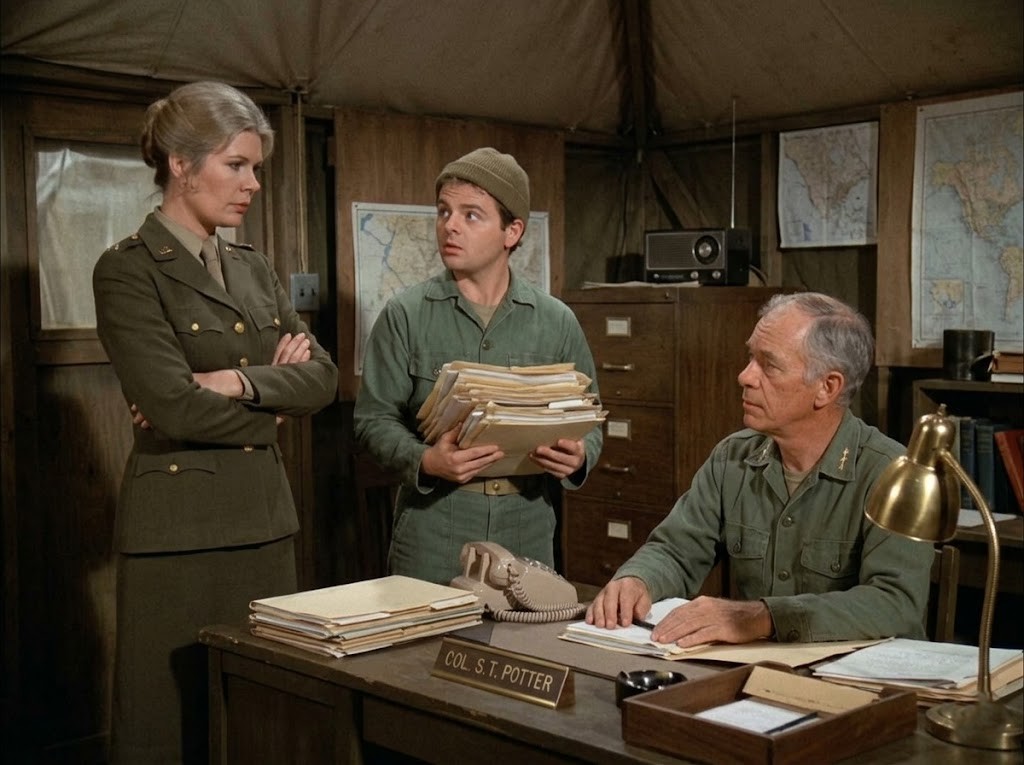
Colonel Sherman T. Potter sat behind his desk, his spectacles resting precariously on the bridge of his nose.
His pen was poised over a mountain of requisitions, but his fingers had stopped moving.
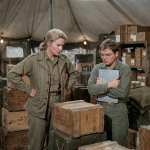
Beside him, Major Margaret Houlihan stood with her arms tightly crossed, her posture rigid, her uniform immaculate despite the humidity.
Her eyes were fixed on the young corporal who had just crossed the threshold, clutching a bundle of folders so high it nearly brushed his chin.
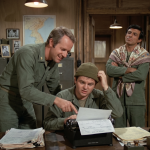
Radar O’Reilly looked like a turtle trying to retreat into its own shell, his woolen beanie pulled low over his ears.
“Corporal,” Margaret said, her voice cutting through the scratch of Potter’s pen. “Tell me those are not more transfer requests for the nursing staff.”
Radar swallowed hard, his eyes darting between the formidable Major and the quiet, steady presence of the Colonel.
“Well, ma’am, technically speaking, they aren’t all transfers,” Radar stammered, his voice squeaking slightly under the pressure.
“Some of them are supply discrepancies, some are form 104-Bs, and… well, there’s a small issue with the monthly intake reports.”
“A small issue?” Margaret stepped forward, her jaw tightening. “Radar, my nurses have been pulling double shifts for forty-eight hours straight. We are exhausted, we are short on penicillin, and now you’re telling me the paperwork is blocked?”
Potter raised a hand, a silent command that instantly halted the rising volume in the room.
He looked up, his weathered face etched with the deep lines of a man who carried the weight of three hundred souls on his shoulders.
“Son,” Potter said softly, his voice a dry, gravelly rumble. “Just give it to me straight. Is the 8063rd jumping our claim on the plasma shipment again?”
Radar didn’t answer right away. He shifted his weight, his knuckles turning white around the edges of the folders.
The silence stretched, heavy and expectant, filled only with the distant hum of the generator outside.
It was the kind of silence that usually preceded a mortar shell or a sudden influx of choppers, but today, it was just the heavy burden of a war that ran on ink and bureaucracy.
Radar looked at the Colonel, his eyes wide with a mixture of fear and profound apology.
“It’s worse than the plasma, Colonel,” Radar whispered, his voice cracking. “The brass in Seoul… they lost the records for the entire month of May.”
The words seemed to hang in the damp air of the tent, freezing the three of them in place.
To anyone outside the 4077th, a missing month of paperwork might sound like a bureaucratic minor nuisance.
But to the people in this room, May wasn’t just a collection of forms.
May was the three-day push at the Changjin reservoir.
May was the night the generator blew and they operated by flashlight.
May was the names of the boys they had patched up, sent home, or wept over when the tables went cold.
Margaret’s arms slowly uncrossed, her professional armor cracking just enough to show the deep, bone-weary fatigue underneath.
“They lost them?” she asked, her voice dropping its military edge, replaced by a quiet, fierce disbelief. “The surgical logs? The discharge summaries? Everything?”
Radar nodded miserably, lowering the stack of papers onto the desk with a dull thud.
“They say if we can’t reproduce the duplicate signatures and the intake stamps by midnight, the supply lines for next month will be docked thirty percent. Including the surgical dressings.”
Potter didn’t explode. He didn’t yell or throw his pen across the room.
Instead, he slowly took off his glasses, set them on the blotter, and rubbed the bridge of his nose where the plastic had left a red mark.
He looked at the towering stack of files Radar had just deposited.
“Thirty percent,” Potter murmured, looking not at the papers, but through them, seeing the empty supply shelves, the unbandaged wounds, the cost of a clerk’s mistake three hundred miles away.
He looked up at Margaret, and for a fraction of a second, the old cavalryman looked his age.
Then, the steel came back into his eyes.
“Major,” Potter said, his voice steadying the room like an anchor. “I believe your nurses keep a private log of patient admissions in the triage tent.”
“We do, Colonel,” Margaret said, her posture instantly straightening again, the professional strength rushing back to fill the void. “Every single name, rank, and serial number.”
“Get it,” Potter ordered gently. “And Radar, go find Pierce and Hunnicutt. Tell ’em to leave the gin alone for tonight. We’ve got a mountain to move, and we’re going to need every drop of ink in this camp.”
Radar’s face flooded with relief, a small, grateful smile tugging at the corner of his mouth. “Yes, sir! Right away, sir!”
As Radar scrambled out of the tent, Margaret paused at the doorway, looking back at the Colonel.
The tension was still there, but it had transformed into something else—the quiet, unbreakable solidarity that kept the 4077th alive.
“We’ll find every name, Sherman,” she said softly, using his first name in that rare, tender way that signaled family rather than rank.
“I know we will, Margaret,” Potter replied, picking up his pen once more. “The army might forget what happened here, but we damn well won’t.”
The tent flap fell shut, leaving the Colonel alone with his papers, the brass lamp casting a warm, golden glow over the desk, fighting back the gathering dark.
In a place where tomorrow was never promised, they fought just as hard to make sure yesterday wouldn’t be forgotten.