Breaking News: AI “Finds” 25 Heat-Resistant Magnets in Hours — A Shortcut Through Decades of Trial-and-Error
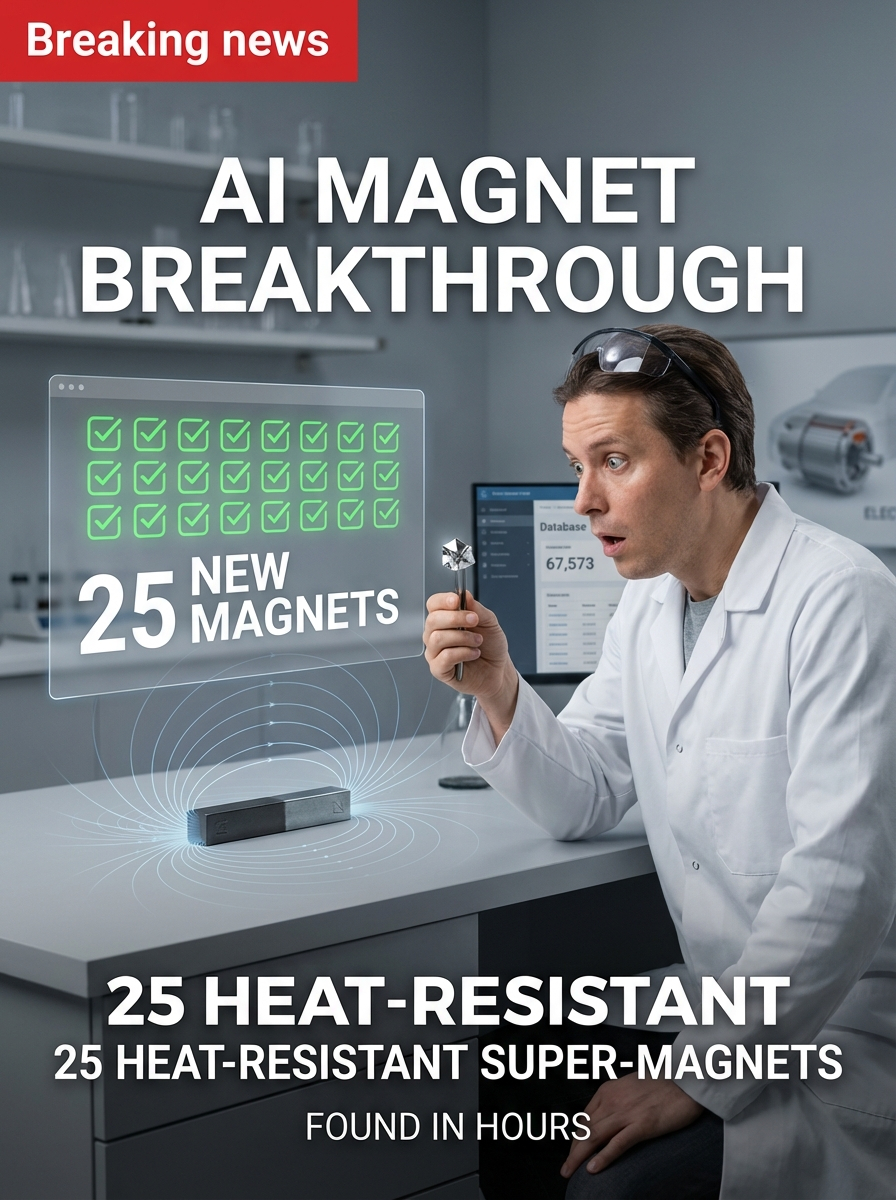
Scientists have used an artificial-intelligence pipeline to flag 25 previously unreported, high-temperature ferromagnetic candidates—materials that could one day reshape motors, generators, and the hardware behind the clean-energy race. The work, led by researchers at the University of New Hampshire, built what they call the Northeast Materials Database (NEMAD) by using large language models to extract experimental magnetic data from the scientific literature at scale.
The result is a searchable dataset of 67,573 magnetic materials entries, including chemical compositions, structures, and key transition temperatures—exactly the kind of fragmented information that normally forces research teams to spend years hunting through papers, handbooks, and tables.
Once the database was assembled, the team trained machine-learning models to classify magnetic behavior and predict when materials lose magnetism as they heat up. In the peer-reviewed report, the authors describe a classifier reaching ~90% accuracy and regression models that can estimate Curie and Néel temperatures with strong performance metrics—then used those models to screen external databases for standout candidates.
That screening produced the headline: 25 ferromagnetic candidates predicted to have Curie temperatures above 500 K (a high bar for many practical applications), plus additional antiferromagnetic candidates. The paper notes that some predictions were later found to match existing experimental reports, while the remaining candidates represent targets for urgent lab validation.
The promise is enormous—and unsettling. If these candidates hold up experimentally, the downstream impact could include less reliance on rare-earth-heavy magnet supply chains, cheaper electric drivetrains, and faster iteration cycles for industrial hardware. But the “secret sauce” is also the warning label: the AI can accelerate discovery, yet the final verdict still belongs to experiments.