🇫🇷🇪🇺⚠️ Macron Warns Europe to Prepare for More U.S. Hostility
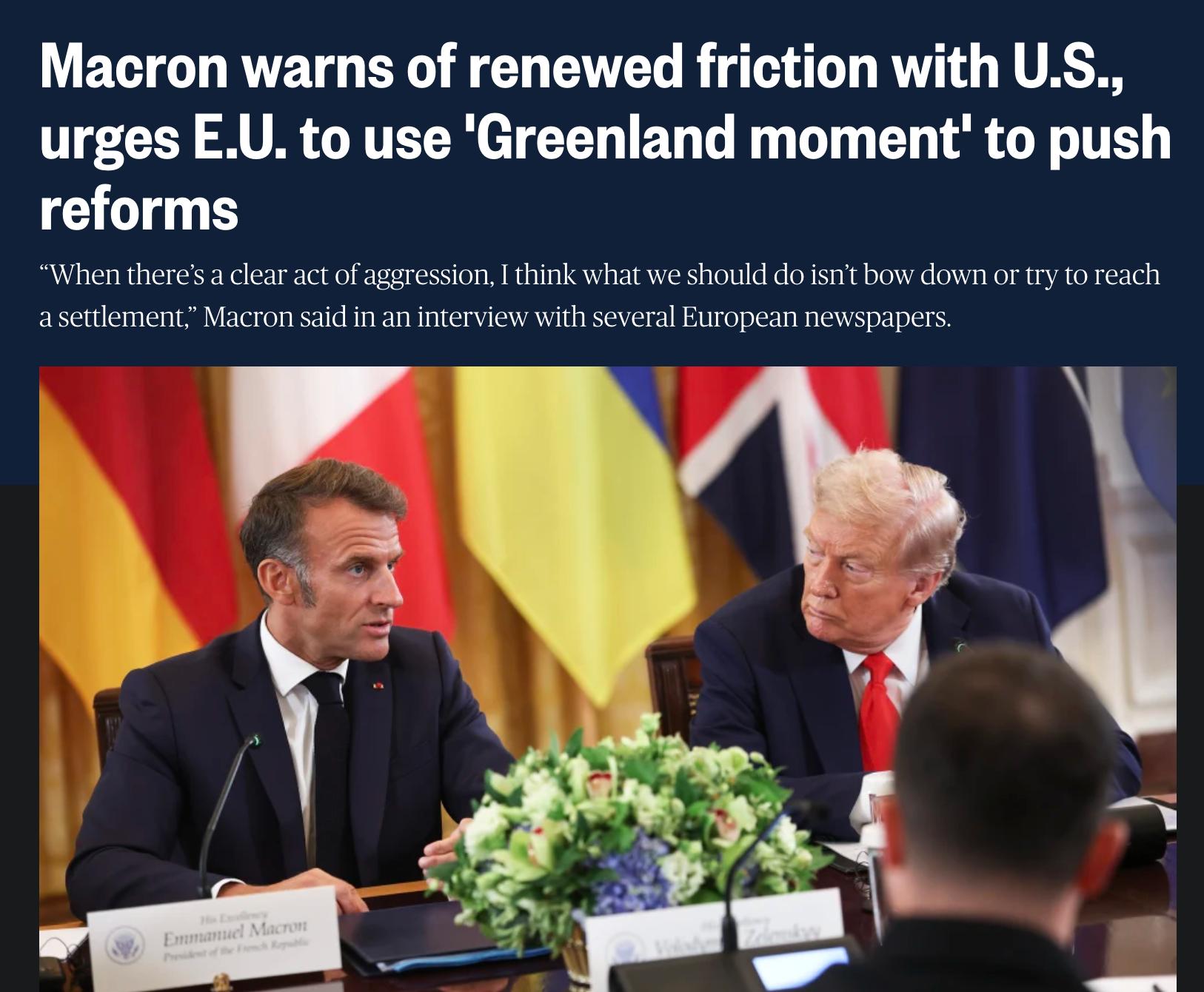
🇫🇷🇪🇺⚠️ Macron Warns Europe to Prepare for More U.S. Hostility
French President Emmanuel Macron has urged European leaders to brace for continued tensions with the United States, warning that recent disputes — including what he called the “Greenland moment” — should serve as a wake-up call for the European Union.
In interviews with Le Monde and the Financial Times, Macron said Europe must not mistake a temporary pause in U.S. pressure for long-term stability.
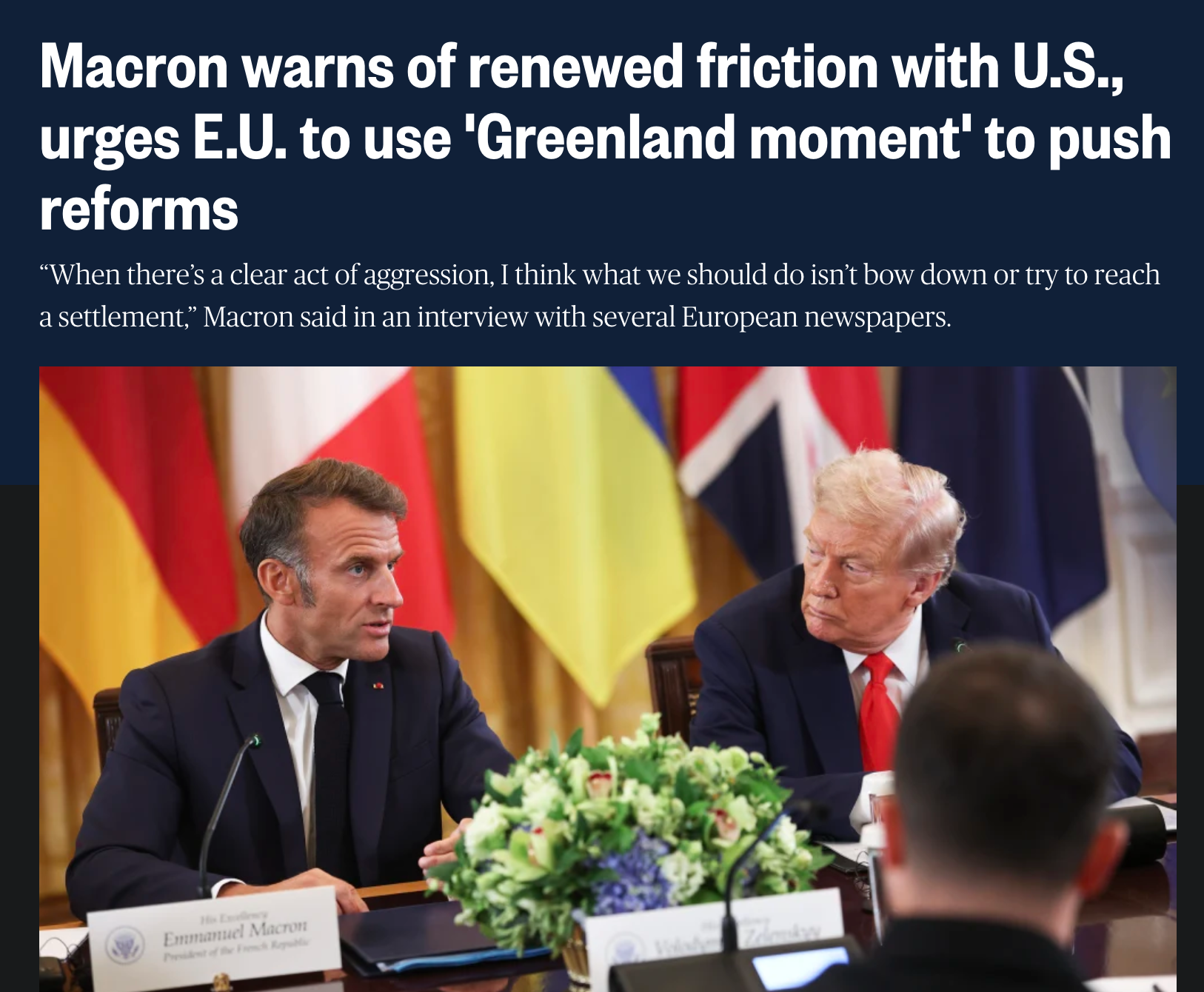 🌍 The “Greenland Moment” and Strategic Shock
Macron referenced renewed tensions surrounding Greenland, after President Donald Trump revived controversial rhetoric about U.S. control over the Arctic territory.
For Macron, the episode symbolized a broader shift in transatlantic relations — one in which Europe can no longer assume automatic alignment with Washington.
He cautioned that disputes over:
-
🌐 Trade policy
-
💻 Technology regulation
-
🧊 Arctic geopolitics
…could quickly resurface.
🇧🇪 EU Leaders Urged to Act
Macron’s warning came as European leaders gathered in Belgium for high-level meetings focused on economic resilience and strategic autonomy.
He called for accelerating long-delayed economic reforms to:
-
📈 Boost competitiveness
-
🏭 Strengthen industrial policy
-
🛡️ Reduce external dependency
-
🌍 Better position Europe between the U.S. and China
Macron has long advocated for greater European “strategic sovereignty,” arguing that the bloc must be capable of defending its own economic and technological interests.
💻 Digital Regulations in the Crosshairs
One of the most contentious issues is Europe’s digital regulatory framework, particularly the Digital Services Act.
The legislation imposes stricter rules on major tech platforms regarding content moderation, transparency, and user protection. U.S. officials and technology firms have previously expressed concerns that such regulations disproportionately affect American companies.
Macron warned that Washington could target the European Union over digital policies, potentially escalating trade and regulatory disputes.
🇺🇸 “Openly Anti-European” Approach?
In unusually blunt language, Macron accused the Trump administration of being “openly anti-European.”
💬 “We’ve tried to reach a settlement for months. It’s not working,” he said, predicting further friction in the months ahead.
His comments reflect growing concern among some European policymakers that transatlantic ties are entering a more transactional and confrontational phase.
🌐 Europe Between Washington and Beijing
Macron’s broader message is that Europe must prepare for pressure not only from the United States but also from China.
He argues that without stronger economic foundations and unified political will, Europe risks becoming squeezed between the world’s two largest powers.
Key priorities include:
-
Investment in green technology 🌱
-
Semiconductor independence 💾
-
Defense cooperation 🛡️
-
Trade diversification 🚢
🕊️ Conclusion: A Turning Point for Transatlantic Relations?
Macron’s warning signals a significant moment in Europe’s strategic thinking. While the United States remains a key ally, recent disputes — from Greenland to digital regulation — have prompted calls for greater European resilience.
Whether the current tensions represent a temporary phase or a deeper structural shift in transatlantic relations remains uncertain. What is clear, however, is that European leaders are increasingly debating how to safeguard the bloc’s autonomy in a rapidly evolving global order. 🌍