🇺🇸⚖️ Virginia Supreme Court Rules Marine Couple Can Keep Afghan Orphan
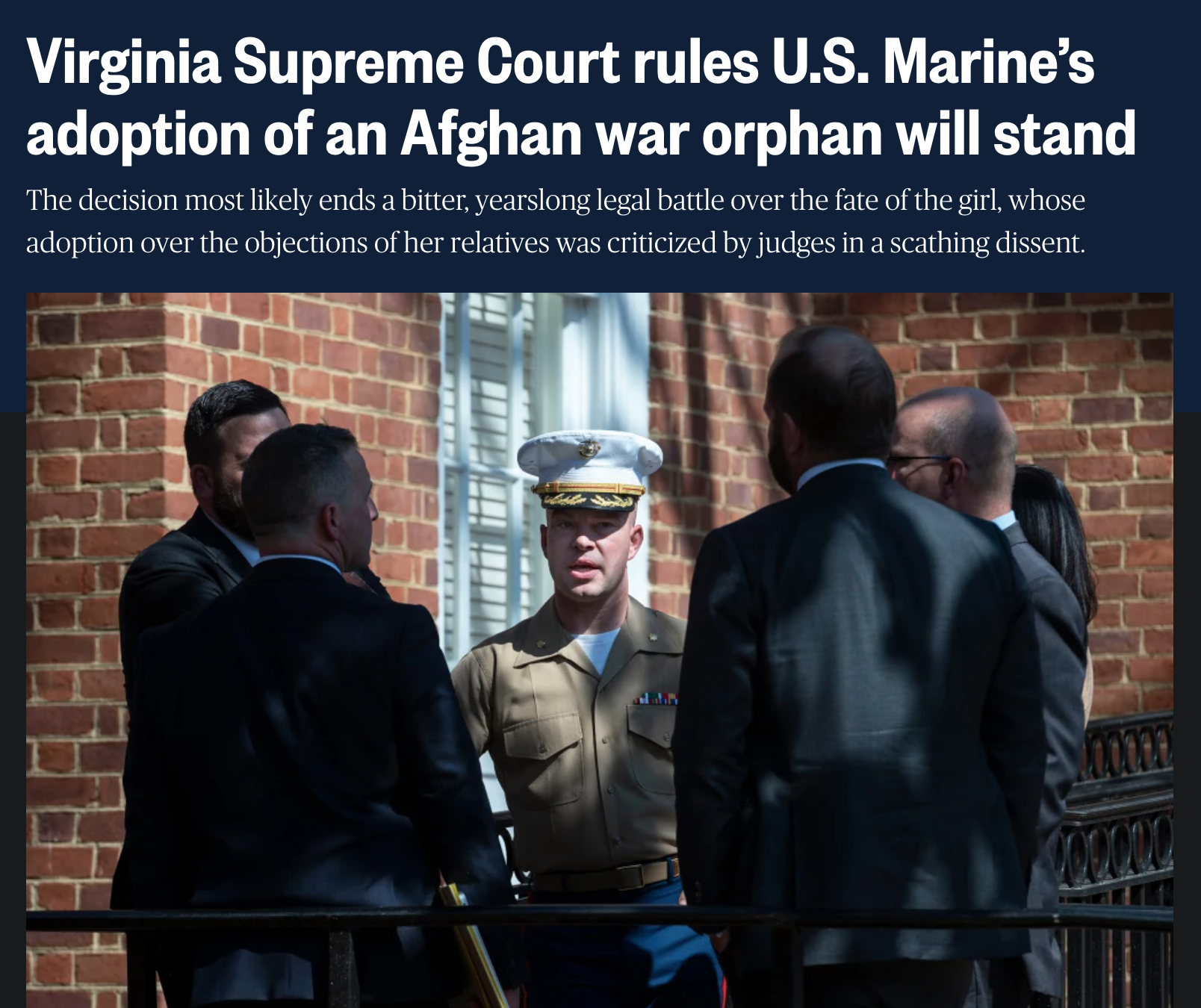
🇺🇸⚖️ Virginia Supreme Court Rules Marine Couple Can Keep Afghan Orphan
The Virginia Supreme Court ruled Thursday that a U.S. Marine and his wife may retain custody of an Afghan girl they adopted in 2020, bringing an emotional and highly contested legal battle closer to its end.
The case centered on the adoption of an Afghan orphan brought to the United States by Joshua Mast and Stephanie Mast, raising complex legal questions about international adoption, jurisdiction, and procedural safeguards.
 🏛️ Adoption Granted While Child Was in Afghanistan
In 2020, a judge in Fluvanna County approved the Mast family’s adoption petition while the child was still living in Afghanistan with relatives who were recognized by the Afghan government.
The adoption order became the focal point of years of litigation. Lower courts had previously ruled the adoption invalid, citing what they described as serious procedural flaws and concerns about how the order was obtained.
However, the Virginia Supreme Court reversed those decisions.
⚖️ Four Justices Reverse Lower Court Rulings
In a majority opinion, four justices overturned earlier rulings that had declared the adoption void. Their reasoning relied heavily on a specific Virginia statute that cements adoption orders after six months, preventing further legal challenges once that period has passed.
Importantly, the majority emphasized that the law blocks subsequent challenges even if the adoption order was allegedly obtained by fraud, underscoring the legislature’s intent to ensure finality and stability in adoption cases.
The court’s decision effectively shields the adoption from further judicial review under state law.
🗣️ Strong Dissent From Three Justices
Not all members of the court agreed. Three justices issued a sharply worded dissent, describing the case as:
-
“Wrong”
-
“Cancerous”
-
“Like a house built on a rotten foundation”
The dissent argued that serious legal flaws in the adoption process should not be insulated from scrutiny simply because of procedural time limits. The minority opinion reflects deep divisions within the court about balancing finality in adoption proceedings with concerns over fairness and due process.
🌍 International Adoption and Legal Complexity
The case highlights broader challenges surrounding international adoptions, especially those involving conflict zones.
Key legal questions raised during the dispute included:
-
Jurisdiction of U.S. courts over children abroad
-
Recognition of foreign guardianship rights
-
Due process in cross-border adoption proceedings
-
The balance between legal finality and alleged procedural misconduct
Legal experts note that international adoption cases can become particularly complex when overlapping legal systems and diplomatic considerations are involved.
📰 Reaction and Next Steps
Attorneys for both sides declined public comment following the ruling. While the decision likely brings the state-level dispute to a close, the case has already drawn national attention due to its sensitive humanitarian and legal dimensions.
The ruling underscores the power of statutory time limits in adoption law and reinforces the principle that, in Virginia, finalized adoption orders gain strong legal protection after six months.
🕊️ Conclusion: A Divided Court, a Final Outcome
The Virginia Supreme Court’s decision allows the Marine couple to retain custody of the Afghan child, potentially ending a yearslong legal struggle. Yet the sharp dissent reveals how deeply contested the case was — both legally and ethically.
As the matter concludes, it leaves behind important questions about international adoption procedures, judicial oversight, and the balance between legal certainty and accountability in complex family law disputes.