🇮🇷 Iran Signals Openness to Nuclear Talks While Drawing a Clear Red Line
🇮🇷 Iran Signals Openness to Nuclear Talks While Drawing a Clear Red Line
📍 Tehran — Iran announced Wednesday that it is willing to negotiate with the United States over its nuclear program, signaling potential diplomatic movement at a highly sensitive geopolitical moment. However, Iranian officials made clear that any talks would be strictly limited to nuclear issues, firmly rejecting broader discussions that could expand into other areas of security policy.
The statement comes amid renewed international focus on Iran’s nuclear ambitions and growing tensions in the Middle East. While Tehran’s message suggests openness to diplomacy, it also reinforces boundaries that could complicate negotiations.
 ☢️ Nuclear Program at the Center of Potential Talks
Iranian leaders emphasized that discussions with Washington would focus solely on the nuclear file. Expanding negotiations to include regional influence or ballistic missile capabilities remains a red line for Tehran.
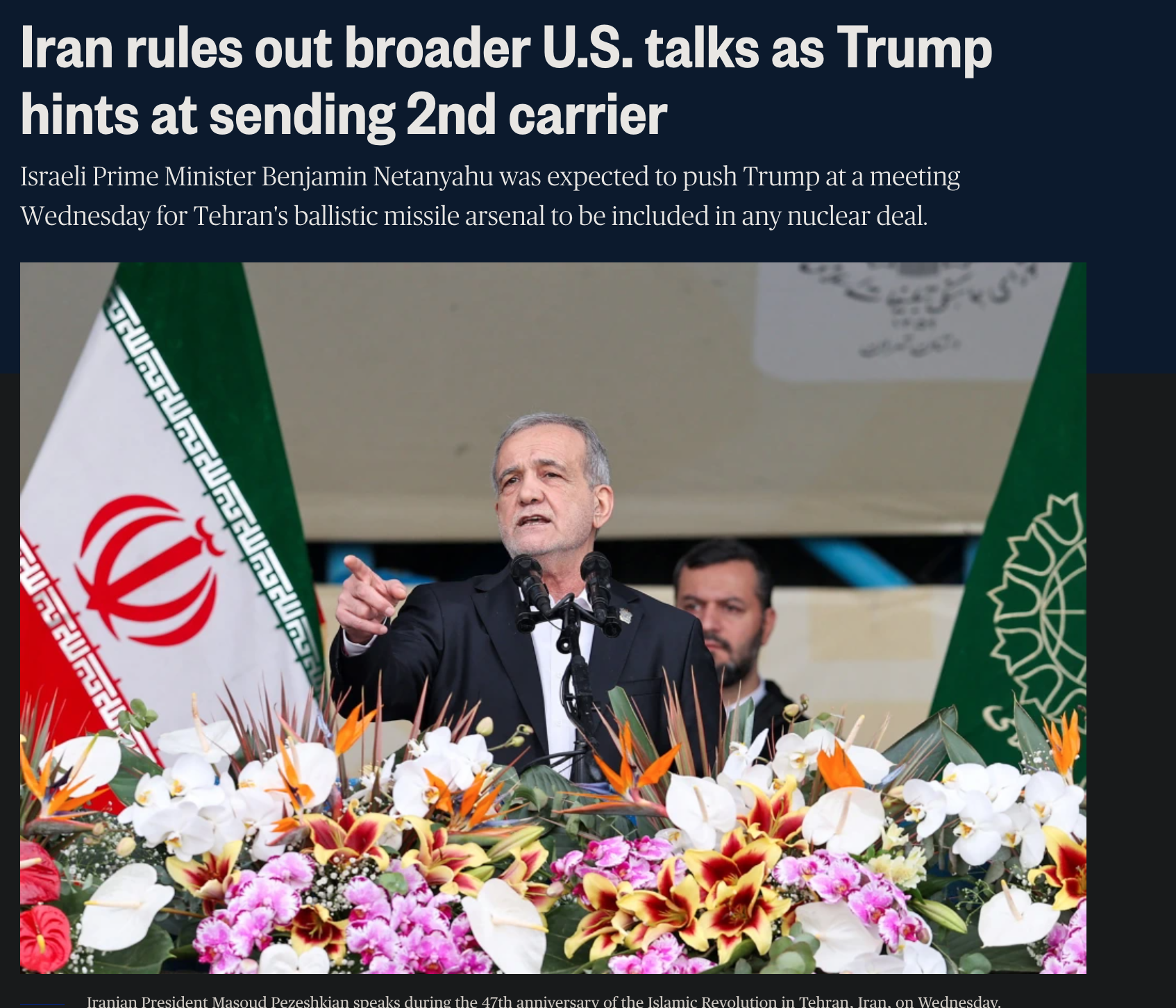
Marking the 47th anniversary of the Islamic Revolution, President Masoud Pezeshkian addressed crowds in Tehran, stating, “We are not seeking nuclear weapons and we are ready for any kind of verification.” His remarks were aimed at reassuring the international community while reinforcing Iran’s longstanding position that its nuclear program is for peaceful purposes.
The reference to verification suggests Tehran may be open to enhanced monitoring mechanisms, a key demand in past nuclear agreements. However, analysts note that the scope and enforcement of such verification would likely be central points of negotiation.
🇺🇸 U.S. Pressure and Strategic Signals
Former President Donald Trump has combined diplomatic outreach with heightened pressure tactics. Reports indicate he has suggested deploying another aircraft carrier group to the Middle East, a move widely interpreted as a signal of deterrence amid ongoing tensions.
Trump was also scheduled to meet Israeli Prime Minister Benjamin Netanyahu, who is expected to advocate for including Iran’s ballistic missile program in any future agreement. Israel has consistently argued that missile capabilities and regional security concerns cannot be separated from the nuclear issue.
This divergence in priorities could present a major obstacle. While Washington and its allies may seek a broader framework, Iran’s insistence on limiting talks to nuclear matters highlights the diplomatic gap that must be bridged.
🌍 Regional and Global Implications
The possibility of renewed U.S. Iran nuclear negotiations carries significant implications for regional stability. Middle Eastern allies, European governments, and global energy markets are closely monitoring developments.
Any breakthrough could ease sanctions pressure and reduce the risk of military escalation. Conversely, failure to align expectations on negotiation scope could deepen mistrust and intensify strategic competition.
Observers note that the combination of diplomatic signals and military posturing reflects the complex balance between deterrence and dialogue that has long defined U.S. Iran relations.
🕊️ Domestic Context and Public Acknowledgment
In his anniversary speech, President Pezeshkian also acknowledged the “great sorrow” caused by the government’s crackdown during the recent wave of unrest. The statement marked a rare public recognition of internal tensions, though it did not signal specific policy changes.
The acknowledgment comes as Iran navigates both domestic challenges and international negotiations. Leaders appear eager to project stability and openness to dialogue while maintaining firm positions on sovereignty and national defense.
As discussions potentially move forward, the world will be watching whether diplomatic channels can produce meaningful progress or whether entrenched differences will once again stall negotiations.