🇪🇺 Macron Warns Europe: The “Greenland Moment” Signals a Strategic Turning Point
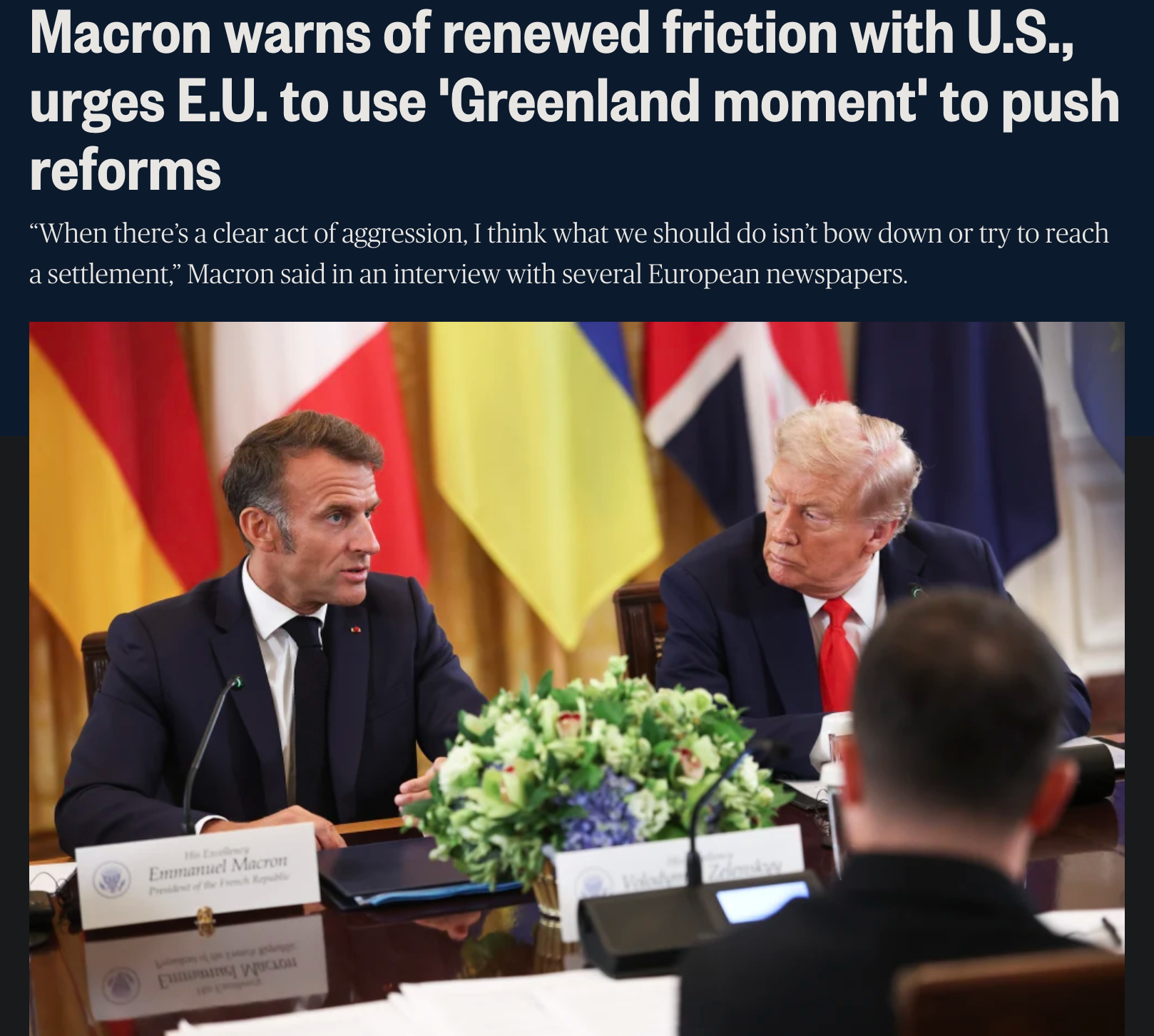
🇪🇺 Macron Warns Europe: The “Greenland Moment” Signals a Strategic Turning Point
📍 Brussels — French President Emmanuel Macron has delivered a stark warning to European leaders, urging the European Union to prepare for what he described as growing hostility from the United States. Referring to the so called “Greenland moment,” Macron said the episode should serve as a wake up call for Europe to reinforce its sovereignty, economic strength, and global influence.
In interviews with major European newspapers ahead of this week’s E.U. summit in Belgium, Macron cautioned against interpreting recent temporary easing of tensions with Washington as a sign of long term stability. Disputes over Greenland, trade policy, and technology regulation, he argued, reveal deeper structural tensions in transatlantic relations.
 🌍 Transatlantic Relations Under Strain
Macron emphasized that Europe must be realistic about its strategic environment. While diplomatic gestures may reduce immediate friction, he warned that underlying disagreements remain unresolved. Issues ranging from territorial rhetoric to trade imbalances and digital governance continue to test the relationship between Brussels and Washington.
“When there’s a clear act of aggression, we shouldn’t bow down,” Macron stated, signaling that Europe should adopt a firmer posture in defending its interests. He added that recent attempts to calm tensions “are not working,” suggesting that stronger and more unified European responses are necessary.
The French president accused the Trump administration of being openly anti European and even seeking what he described as the bloc’s dismemberment. His remarks reflect growing concern among some European leaders that U.S. political shifts could challenge the unity and autonomy of the European Union.
🏰 E.U. Summit Focused on Competitiveness and Reform
Ahead of the Brussels summit, Macron called for accelerating long delayed economic reforms aimed at boosting European competitiveness. He urged leaders to reduce bureaucratic barriers, strengthen industrial policy, and invest in innovation to ensure that Europe can compete more effectively with both China and the United States.
According to Macron, economic resilience is central to geopolitical strength. A more competitive Europe, he argued, would be better positioned to defend its trade interests, technological standards, and regulatory frameworks in an increasingly multipolar world.
The summit is expected to address strategic autonomy, defense coordination, and industrial policy, all areas that Macron has consistently championed as pillars of European sovereignty.
💻 Digital Regulation and Trade Tensions Loom
Macron also warned that future disputes may center on Europe’s digital regulations, particularly the Digital Services Act. The legislation, designed to regulate large technology platforms and protect online users, has drawn criticism from some U.S. political figures and technology companies.
He suggested that Washington could challenge these regulations and potentially respond with new import tariffs in the coming months. Such measures would risk escalating trade tensions at a time when global economic stability remains fragile.
European officials are increasingly aware that technology policy has become a frontline issue in geopolitical competition. Control over digital standards, data governance, and artificial intelligence development is now closely tied to economic power and national security.
📊 A Defining Moment for European Strategy
Macron’s warning underscores a broader debate within the European Union about its long term strategic direction. Should Europe continue relying heavily on the transatlantic alliance, or should it accelerate efforts to build independent economic and defense capabilities?
The so called Greenland moment, in Macron’s view, illustrates the unpredictability of global politics and the need for Europe to act decisively. Strengthening internal unity, investing in competitiveness, and defending regulatory sovereignty are central to his message.
As leaders gather in Belgium, the outcome of the summit could shape Europe’s posture toward both Washington and Beijing in the years ahead. The question now facing the bloc is whether it will treat this moment as a temporary dispute or as a catalyst for lasting transformation.