☢️ U.S.–China Clash Erupts After Nuclear Treaty Expiration
☢️ U.S.–China Clash Erupts After Nuclear Treaty Expiration
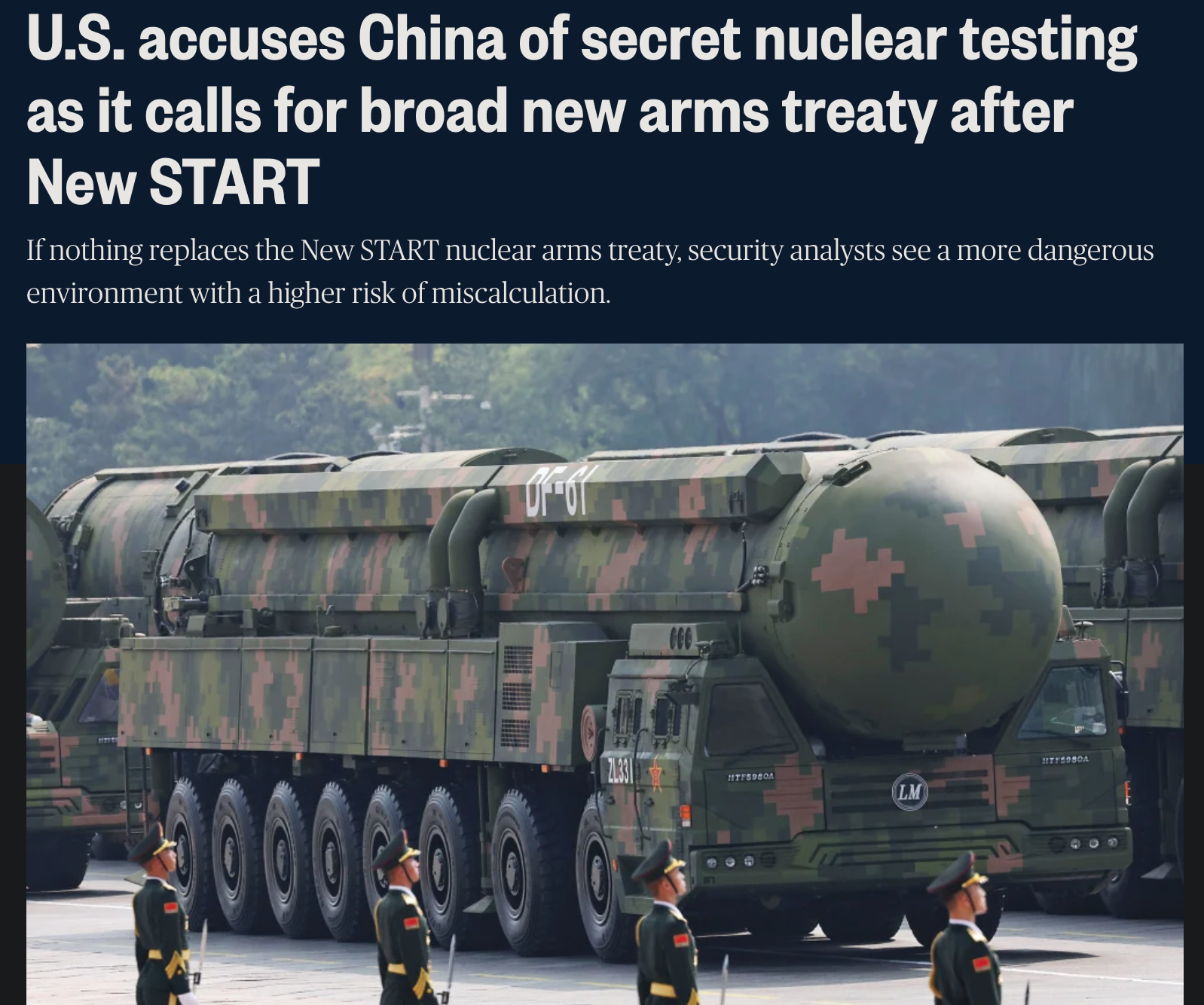
Global nuclear tensions escalated sharply as the United States and China exchanged accusations at a major disarmament conference — just one day after the treaty limiting U.S. and Russian missile and warhead deployments officially expired.
The lapse of the long standing arms control agreement has intensified concerns about a new era of unchecked nuclear competition, with diplomats warning that global stability may be entering a more uncertain phase.
 🇺🇸 U.S. Alleges Secret Chinese Nuclear Tests
U.S. Under Secretary of State Thomas DiNanno alleged that China conducted nuclear explosive tests, including preparations for tests with yields in the hundreds of tons. According to DiNanno, Beijing attempted to conceal the tests using a method known as “decoupling,” a technique designed to reduce seismic signals and limit detection.
He also cited what he described as a “yield-producing test” on June 22, 2020, raising questions about transparency and compliance with international norms.
The allegations mark one of the most direct public accusations by Washington regarding China’s nuclear testing activities in recent years.
🇨🇳 China Rejects “Nuclear Threat” Narrative
China’s ambassador Shen Jian did not directly respond to the specific claims but firmly rejected what he called the “China nuclear threat” narrative. He insisted that Beijing acts prudently and responsibly in its defense policy.
Shen countered by accusing the United States of fueling a global arms race, pointing to U.S. military modernization efforts and strategic deployments as destabilizing factors.
Beijing has consistently maintained that its nuclear arsenal remains defensive in nature and significantly smaller than those of the United States and Russia.
🌍 Growing Uncertainty in Global Arms Control
Diplomats attending the conference described the U.S. allegations as new and deeply concerning. The expiration of the treaty limiting U.S. and Russian strategic weapons has already raised fears of a renewed nuclear buildup. The fresh exchange between Washington and Beijing adds another layer of instability.
Experts warn that without updated arms control frameworks, misunderstandings and mistrust between major powers could escalate further. Calls are growing for renewed dialogue, transparency measures, and expanded multilateral agreements that include China in future arms control discussions.
As geopolitical rivalry intensifies, the confrontation highlights a broader shift in the global security landscape — one where traditional treaties are weakening and new strategic rivalries are emerging.